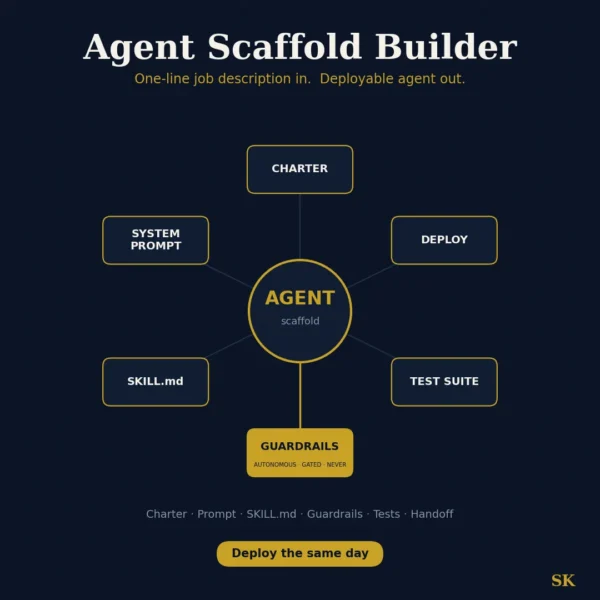
Agent Scaffold Builder
$8.99View skill
Skill · AI & Development
UI Design Taste Critic is a Claude skill for AI & Development. Get ruthless, systemic UI critiques with concrete spacing and typography values to fix amateur designs. It costs $7 on Agensi. It runs on any Claude plan, including Free. Part of the StrategistKit catalog of 190+ focused Claude skills.
10 credits — included with a membership (30 credits/mo).
Prefer a one-time purchase, without joining?
Buy once on Agensi (opens in a new tab)StrategistKit Affiliate. One-time purchase on Agensi. Payment, delivery and refunds are handled by the marketplace — see their policy for refund terms.
Overview
UI Design Taste Critic performs a structured, systemic audit of your component code, Tailwind layouts, or CSS mockups — not a surface-level opinion pass. It checks eight distinct dimensions: visual hierarchy against information priority, spacing rhythm, typography scale discipline, colour semantics, alignment and grid integrity, contrast and visual weight, density and whitespace balance, and component consistency. Every finding it raises must carry a concrete replacement value — a specific px token, a Tailwind class swap, a hex — or it does not appear in the report.
A typical session: you paste a React card component using inconsistent padding and three different font weights, tell the skill your stack is Tailwind and your audience is paying B2B customers. It asks four brief questions — stack, goal, constraints, audience — then returns a ranked audit. Example output excerpt: 'CRITICAL (high impact / low effort): Card padding uses p-3 on inner content and p-5 on the container, breaking the 8px grid. Change inner padding to p-4. MEDIUM: Two competing text-gray-500 and text-gray-400 body classes create an unintentional hierarchy; consolidate to text-gray-500 for all secondary copy. CONSIDER: Border radius mixes rounded and rounded-md across sibling components; standardise to rounded-md.'
The Impact-per-Effort ranking at the end of every audit tells you exactly which changes to ship first and which to defer. Output format adapts to your workflow: a structured report for a design review meeting, a quick bullet list for a solo iteration sprint, or copy-paste-ready Tailwind specifications you can drop straight into your codebase. Nothing vague, nothing without a number attached.
Who it's for
Solo developers and small product teams who can feel that a UI looks unpolished but lack the design vocabulary or system-level intuition to diagnose and fix it precisely. It is also useful for designers who want a second, unsentimental pass before handing off to engineering.
How it works
Add the .skill file to your Claude app. About 10 seconds.
Invoke the skill and paste in your material.
Review, keep what works, and use it.
In depth
A copy-paste prompt runs one static pass and stops. A skill is a bundled program — instructions, examples, and a workflow Claude runs as a unit: it asks for the right input, applies the same pattern every time, and returns the structured outputs above.
FAQ
Component code (JSX, HTML, CSS, or Tailwind classes) gives the most precise output. Descriptive mockup text or a written layout description also works, though the skill will flag assumptions it has made. The more you describe your stack and intended audience upfront, the more targeted the critique.
Stack-specific fixes. If you are on Tailwind it returns Tailwind class names. If you are on vanilla CSS it returns px or rem values. It asks about your stack in the opening context questions before generating any output.
The default report is sectioned by audit dimension and closes with an Impact-per-Effort ranking. If you need something faster, ask for a quick-fix bullet list or a copy-paste specification block instead. The skill adapts its format to whichever workflow you describe.
It enforces design-system logic even on a single component — it will flag when a component's tokens conflict with a broader system you describe. If you have no system yet, it will identify the inconsistencies that are preventing one from emerging.
Yes. The niche and audience are runtime inputs you supply during the opening context step. The critique logic — hierarchy, spacing rhythm, type scale, colour semantics — applies regardless of whether you are building a SaaS dashboard, a consumer app, or an internal tool.
More in AI & Development
Part of these collections
We use cookies for anonymous analytics (read more). Accept, decline, or choose for yourself.