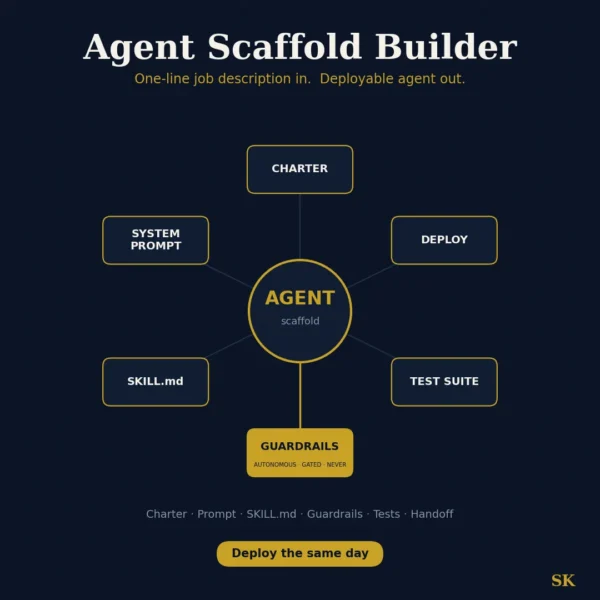
Agent Scaffold Builder
$8.99View skill
Skill · AI & Development
RAG System Designer is a Claude skill for AI & Development. Architect custom RAG pipelines based on your specific data and query patterns. It costs $9.99 on Agensi. It runs on any Claude plan, including Free. Part of the StrategistKit catalog of 190+ focused Claude skills.
10 credits — included with a membership (30 credits/mo).
Prefer a one-time purchase, without joining?
Buy once on Agensi (opens in a new tab)StrategistKit Affiliate. One-time purchase on Agensi. Payment, delivery and refunds are handled by the marketplace — see their policy for refund terms.
Overview
RAG System Designer works through your corpus and query characteristics before recommending anything. It profiles document structure to determine the right chunking strategy, assesses query vocabulary to decide whether dense retrieval alone is sufficient or hybrid search is warranted, and evaluates your tolerance for wrong answers to set grounding strictness. It then produces a full pipeline specification covering chunking approach, embedding model selection, retrieval architecture, metadata filtering, reranking placement, vector store choice, and a golden question set for measuring retrieval quality over time.
A typical input: 'We have 4,000 internal engineering docs ranging from short Confluence pages to 60-page PDF specs. Queries are mix of precise lookups (find the error code for X) and exploratory (how does our auth system handle token expiry). We use Python and Postgres already, and wrong answers in production are a real problem.' That description is enough to start a calibrated design session.
The output is a structured architecture spec, not a list of generic tips. Example excerpt: Chunking — document-aware splitting at section headers with 200-token overlap at boundaries; dense retrieval insufficient given exact-term queries, recommend BM25 + dense hybrid with Reciprocal Rank Fusion; reranking layer not warranted at current corpus size, revisit above 20k chunks; golden set of 40 representative queries defined before first evaluation run; grounding: citation required for every factual claim, refusal on low-confidence retrievals.
Who it's for
Engineers and technical product managers building document QA, internal knowledge bases, or grounded AI assistants who have hit the limits of tutorial-based RAG setups and need retrieval that actually holds up against their specific corpus and production query patterns.
How it works
Add the .skill file to your Claude app. About 10 seconds.
Invoke the skill and paste in your material.
Review, keep what works, and use it.
In depth
A copy-paste prompt runs one static pass and stops. A skill is a bundled program — instructions, examples, and a workflow Claude runs as a unit: it asks for the right input, applies the same pattern every time, and returns the structured outputs above.
FAQ
Describe your corpus (document types, volume, structure), the kinds of queries users will ask, your existing tech stack, and how costly a wrong or hallucinated answer is. The more specific you are, the more calibrated the output. You can also say 'decide for me' and the skill will apply reasoned defaults and flag assumptions.
It produces an architecture specification and actionable decisions you can hand to a developer or use to configure your pipeline. It can include pseudocode or configuration sketches where that clarifies a recommendation, but its primary output is a design document, not a complete implementation.
It adapts to your workflow: a structured spec document for a new build, a short decision list for a quick architecture question, or a checklist of changes if you are improving an existing pipeline. Specify which you need or it will default to a structured document for full design requests.
Yes, and it will give a reason tied to your specific constraints — not a generic comparison table. The recommendation factors in your existing stack, corpus size, whether you need metadata filtering, and operational complexity your team can realistically manage.
Evaluation is part of the design, not an afterthought. The skill specifies a golden question set construction process and the retrieval metrics (precision at k, recall, answer faithfulness) appropriate for your quality bar, because a pipeline without defined metrics cannot be reliably improved.
More in AI & Development
We use cookies for anonymous analytics (read more). Accept, decline, or choose for yourself.