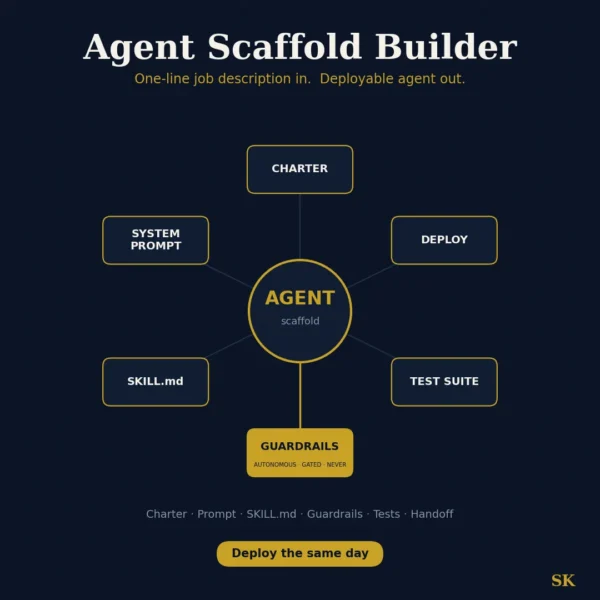
Agent Scaffold Builder
$8.99View skill
Skill · AI & Development
Multi-Agent Orchestrator is a Claude skill for AI & Development. Design robust multi-agent architectures with clear boundaries, failure modes, and handoff logic for complex AI pipelines. It costs $12.99 on Agensi. It runs on any Claude plan, including Free. Part of the StrategistKit catalog of 190+ focused Claude skills.
10 credits — included with a membership (30 credits/mo).
Prefer a one-time purchase, without joining?
Buy once on Agensi (opens in a new tab)StrategistKit Affiliate. One-time purchase on Agensi. Payment, delivery and refunds are handled by the marketplace — see their policy for refund terms.
Overview
Multi-Agent Orchestrator works through your pipeline before you write a single tool call. You describe your goal, available tools, and platform constraints; the skill interrogates the dependency structure of your task, identifies what is genuinely parallel versus what is a serial dependency in disguise, defines the minimum context each subagent needs, specifies output contracts and validation steps between stages, and maps where a failed or malformed agent response would cascade — and how to contain it. The result is an agent graph you can implement directly, not a list of vague suggestions.
A realistic input looks like this: 'I need to process 200 customer support tickets daily — classify intent, draft a reply, and log the outcome to a database. Running on Claude API, one developer, no existing orchestration framework.' The skill returns a structured architecture covering which of those three tasks can fan out in parallel, what each subagent's input contract must contain, how to validate the drafted reply before it reaches the logging step, and what the retry strategy is if the classification agent returns an unexpected label.
Sample output excerpt — Dependency Structure: Classification is a prerequisite for drafting; do not parallelise. Drafting and logging are independent once classification succeeds — fan out there. Per-Agent Brief (Draft Agent): receives {ticket_id, intent_label, raw_ticket_text}; returns {draft_reply: string, confidence: float}. Validation Gate: reject and retry if confidence < 0.7 or draft_reply exceeds 300 words. Failure Mode: if Draft Agent fails after two retries, route ticket to human_review queue and halt logging step.
Who it's for
Engineers and technical leads building multi-step Claude pipelines — whether in Claude Code, the Anthropic API, or a custom framework — who need a sound coordination design before they hit merge conflicts, silent failures, or runaway token costs at runtime. Particularly useful for solo developers tackling their first non-trivial agent system who lack a team to pressure-test the architecture.
How it works
Add the .skill file to your Claude app. About 10 seconds.
Invoke the skill and paste in your material.
Review, keep what works, and use it.
In depth
A copy-paste prompt runs one static pass and stops. A skill is a bundled program — instructions, examples, and a workflow Claude runs as a unit: it asks for the right input, applies the same pattern every time, and returns the structured outputs above.
FAQ
Your goal or task description, the tools or APIs each potential agent could call, the platform you are building on (e.g. Claude Code, raw API, a specific framework), and any hard constraints like latency, cost ceiling, or team size. The more specific your input, the more concrete the returned graph.
Yes — deciding that is part of what the skill does. It analyzes your task's dependency structure and tells you where parallelism actually helps and where it just adds coordination overhead. You do not need to arrive with an agent count in mind.
The skill adapts to what you are building: a structured architecture document with agent briefs and failure-handling specs for complex pipelines, or a concise spec you can paste directly into code comments for simpler flows. You can specify your preferred format; it defaults to the most useful one for your described context.
No. It produces the architecture — the agent graph, per-agent briefs, output contracts, validation gates, and failure strategies. Implementation of the tool calls and orchestration code is your step; this skill ensures you are implementing the right design.
No. Even a three-agent pipeline has coordination decisions that are easy to get wrong silently — context bleed between agents, no validation before handoff, no defined fallback. The skill is proportionate to your complexity; for a small flow it returns a concise brief, not a heavyweight document.
More in AI & Development
Part of these collections
We use cookies for anonymous analytics (read more). Accept, decline, or choose for yourself.