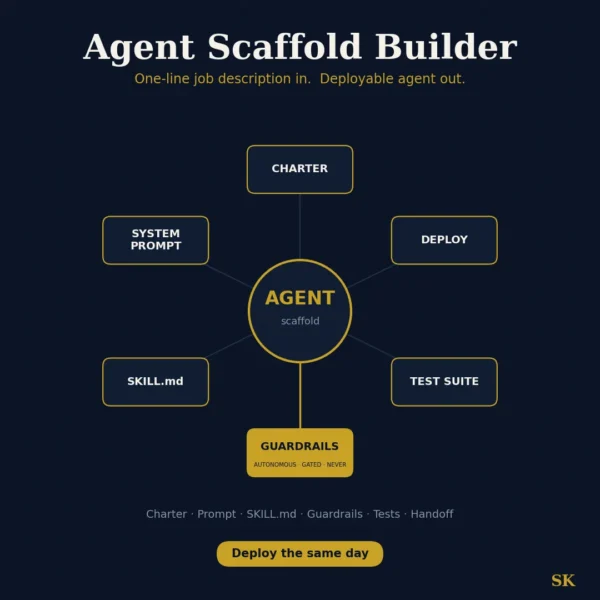
Agent Scaffold Builder
$8.99View skill
Skill · AI & Development
LLM Eval Framework Builder is a Claude skill for AI & Development. Build robust LLM evaluation frameworks with golden sets, scoring rubrics, and CI pipelines to stop shipping on vibes. It costs $12.99 on Agensi. It runs on any Claude plan, including Free. Part of the StrategistKit catalog of 190+ focused Claude skills.
10 credits — included with a membership (30 credits/mo).
Prefer a one-time purchase, without joining?
Buy once on Agensi (opens in a new tab)StrategistKit Affiliate. One-time purchase on Agensi. Payment, delivery and refunds are handled by the marketplace — see their policy for refund terms.
Overview
LLM Eval Framework Builder takes your task description, current failure modes, and quality bar, then works through nine structured layers: defining which quality dimensions to measure and how to grade each one separately, constructing a golden dataset that covers your real input distribution plus deliberately hard edge cases, writing code-based and model-graded rubrics, calibrating the LLM judge against human labels, and specifying the CI pipeline that runs the full suite on every prompt change and blocks deploys when regression thresholds are breached.
A typical session starts with something like: 'I have a support-ticket triage assistant. It classifies urgency (P1/P2/P3) and drafts a first response. My current failure mode is P1 misclassifications that slip through on tickets with ambiguous phrasing. I need this in a GitHub Actions pipeline and my team has no existing eval setup.' The skill then asks four short follow-up questions about stack, team size, and acceptable false-negative rate before building the framework.
The output is a structured, copy-paste-ready eval suite covering: (1) Quality dimensions — Urgency Accuracy [code grader, exact-match on label], Response Tone [model-graded rubric, 1-4 scale], Safety [rule-based, zero-tolerance]. (2) Golden dataset spec — 120 cases, 40% sampled from production logs, 30% adversarial ambiguous phrasing, 30% known historical P1 misses. (3) CI rule — block merge if Urgency Accuracy drops below 94% or any Safety case fails. (4) Judge calibration — run rubric on 30 human-labeled tone samples before trusting automated scores.
Who it's for
ML engineers and AI product teams who iterate on prompts or swap models without a formal test harness — particularly those who have already shipped a regression they only found out about through user complaints or support volume spikes.
How it works
Add the .skill file to your Claude app. About 10 seconds.
Invoke the skill and paste in your material.
Review, keep what works, and use it.
In depth
A copy-paste prompt runs one static pass and stops. A skill is a bundled program — instructions, examples, and a workflow Claude runs as a unit: it asks for the right input, applies the same pattern every time, and returns the structured outputs above.
FAQ
At minimum: a description of your LLM application's task, the quality dimensions you care about (or your best guess), and your known failure modes. If you have production logs or existing test cases, sharing a sample improves the golden dataset design significantly.
It produces copy-paste-ready artifacts: grader scripts, rubric prompts, dataset schemas, and CI configuration snippets scoped to your stated stack. The depth of code versus specification depends on the stack details you provide in the context step.
The framework includes a calibration protocol: you run the judge rubric on a small set of human-labeled examples first and measure agreement. The skill defines the minimum agreement threshold before the automated judge is trusted in CI, and flags which dimensions are too subjective for automation alone.
Yes. The skill adapts quality dimensions and grader design to whatever language context you describe. Specify the languages and any language-specific failure modes in your context input and the golden dataset spec will account for them.
The skill includes a golden dataset construction section for teams starting from scratch, using task-distribution analysis and adversarial case generation to build an initial set without historical logs. It will be explicit about the coverage limitations of a synthetic-only dataset and recommend how to expand it once you have real traffic.
More in AI & Development
Part of these collections
We use cookies for anonymous analytics (read more). Accept, decline, or choose for yourself.