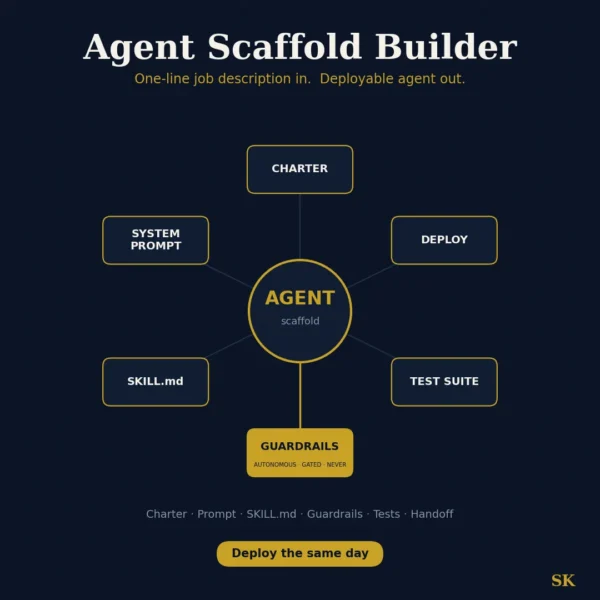
Agent Scaffold Builder
$8.99View skill
Skill · AI & Development
AEO & LLM Discoverability Optimizer is a Claude skill for AI & Development. Optimize your site for ChatGPT and Perplexity with AEO audits, llms.txt templates, and content clarity briefs. It costs $8.99 on Agensi. It runs on any Claude plan, including Free. Part of the StrategistKit catalog of 190+ focused Claude skills.
10 credits — included with a membership (30 credits/mo).
Prefer a one-time purchase, without joining?
Buy once on Agensi (opens in a new tab)StrategistKit Affiliate. One-time purchase on Agensi. Payment, delivery and refunds are handled by the marketplace — see their policy for refund terms.
Overview
This skill audits a website's readiness to be cited by AI answer engines — ChatGPT, Perplexity, Claude, Gemini — rather than ranked by Google. You describe your site and the queries you want to appear in, and the skill works through entity clarity, structured data gaps, llms.txt implementation, FAQ schema, crawlability signals, and the content patterns AI systems prefer to pull from. It returns a prioritized gap assessment, a schema markup action list, a ready-to-deploy llms.txt template, and a rewrite brief for your highest-value pages.
A typical session might start with: 'I run a B2B SaaS site focused on contract management software. Target queries: what is contract lifecycle management, best CLM tools for small legal teams. We have no structured data and no llms.txt.' The skill asks four quick context questions — industry, goal, constraints, audience — then leads immediately with the highest-impact gaps for that site type.
Sample output excerpt — Gap Assessment (Priority 1): No llms.txt found; AI crawlers cannot identify authoritative pages. Recommended action: deploy /llms.txt listing your product overview, pricing, and use-case pages with a one-sentence descriptor per URL. Priority 2: FAQ schema absent on comparison pages — these pages match high-intent AI query patterns but return no extractable answer structure. Schema template provided below for immediate implementation.
Who it's for
Site owners, SEO leads, and content strategists who already invest in organic search and want to extend that visibility into AI-generated answers before competitors do. Particularly useful for teams that have strong content assets but have not yet adapted them for structured, entity-clear, machine-readable formats.
How it works
Add the .skill file to your Claude app. About 10 seconds.
Invoke the skill and paste in your material.
Review, keep what works, and use it.
In depth
A copy-paste prompt runs one static pass and stops. A skill is a bundled program — instructions, examples, and a workflow Claude runs as a unit: it asks for the right input, applies the same pattern every time, and returns the structured outputs above.
FAQ
Your website URL or description, the specific queries you want to appear in AI answers, and any context on your tech stack or content team size. The skill asks four short questions at the start; answers take under two minutes.
It adapts to your goal: a structured audit report with executive summary and findings, a copy-paste-ready llms.txt template, JSON-LD schema snippets, or a plain checklist with owner and timeline fields. State your preference or it defaults to a document for audits and direct bullets for quick questions.
No. It specifically addresses the layer of optimization that standard SEO tools do not cover — entity disambiguation, AI crawlability signals, and content patterns that make pages citable in generated answers. It complements existing keyword and link work rather than substituting for it.
You tell the skill your niche and target queries at runtime; it calibrates its recommendations to that context. If AI answer volume is low for your category, it will flag that and focus effort where the citation opportunity is largest.
Most of the output — the content rewrite brief, llms.txt template, and FAQ copy — requires no coding. The schema markup section includes ready-to-paste JSON-LD; implementing it may need a developer or a CMS plugin, and the skill will note that where relevant.
More in AI & Development
Part of these collections
We use cookies for anonymous analytics (read more). Accept, decline, or choose for yourself.