RAG Failure Diagnostics & Architect
$7View skill
Skill · AI & Development
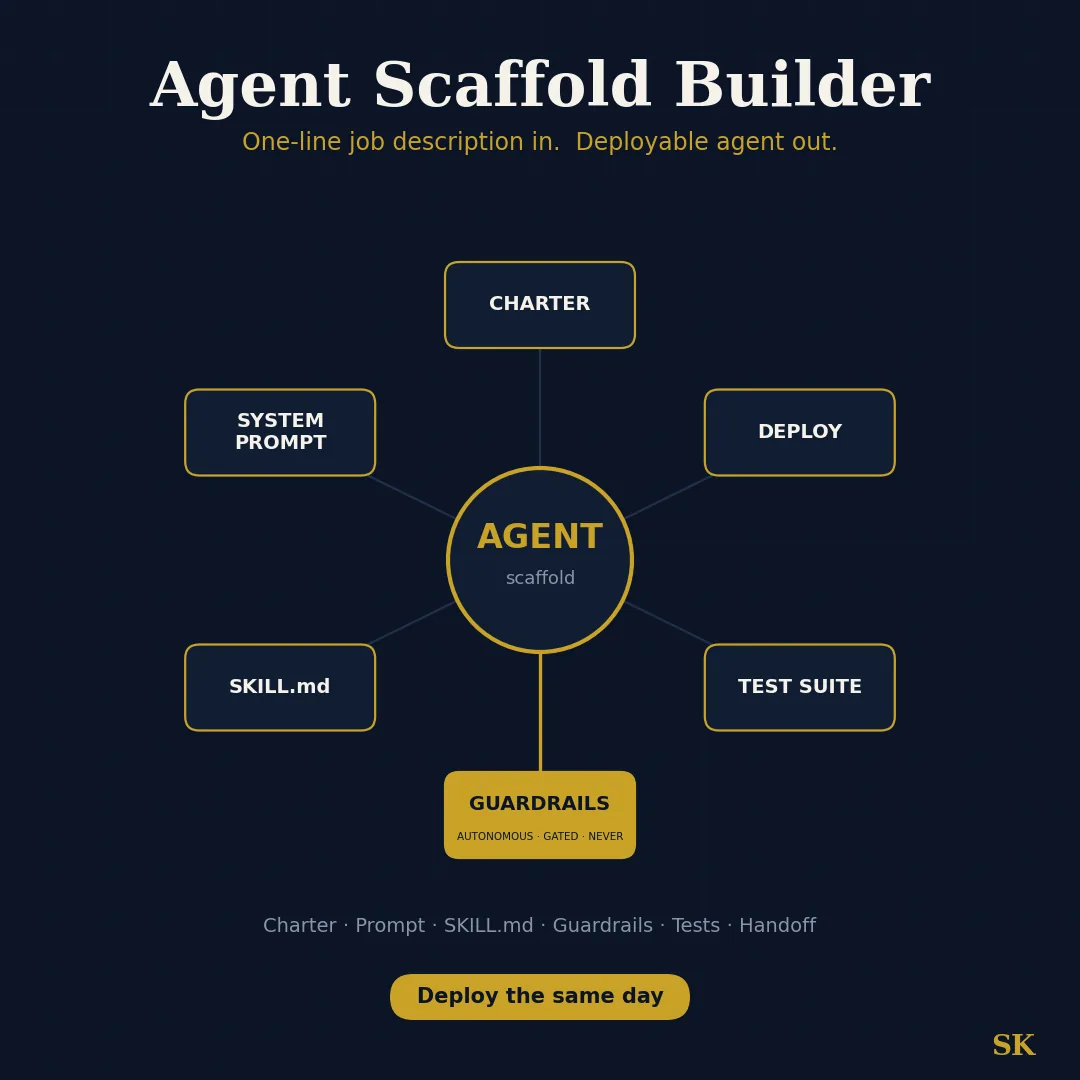
Agent Scaffold Builder is a Claude skill for AI & Development. Turn a one-line job description into a production-ready AI agent scaffold: charter, system prompt, SKILL.md, tool map, three-tier guardrails, test suite, deployment checklist and client handoff doc. It costs $8.99 on PromptBase. It runs on any Claude plan, including Free. Part of the StrategistKit catalog of 190+ focused Claude skills.
10 credits — included with a membership (30 credits/mo).
Prefer a one-time purchase, without joining?
Buy once on PromptBase (opens in a new tab) Also on Agensi (opens in a new tab)StrategistKit Affiliate. One-time purchase on PromptBase. Payment, delivery and refunds are handled by the marketplace — see their policy for refund terms. PromptBase purchases earn us a referral fee.
Overview
Everyone is building AI agents. Almost nobody scaffolds them properly — so they ship agents with tools but no guardrails, memory buried in chat history, and no way to test before something goes wrong. This skill turns a one-line job description into the complete design layer an agent needs before it touches real systems.
Describe the job in one line — 'an agent that triages my support inbox', 'an agent that drafts weekly client reports'. You get back a production-ready scaffold: an agent charter with explicit non-goals, a paste-ready system prompt of at most 400 words, a full SKILL.md file following the universal standard, a tool map with read/write access levels, memory design, a three-tier guardrail table (autonomous / approval-gated / never) including prompt-injection posture, and a step-by-step runbook.
It closes with the operational layer most agent builds skip: a 6-scenario test suite including an injection test, failure-mode planning, a deployment checklist with an iteration loop, and a client-ready handoff document. Works with Claude (Sonnet 4.5+), Claude Code, and any SKILL.md-compatible agent stack.
Who it's for
Consultants and freelancers selling agent builds to clients, indie builders automating their own operations, teams standardizing how agents get designed, and anyone deploying Claude or GPT agents with real tool access.
What you get
One .skill bundle. Run it on your material and it returns:
How it works
Add the .skill file to your Claude app. About 10 seconds.
Invoke the skill and paste in your material.
Review, keep what works, and use it.
In depth
A copy-paste prompt runs one static pass and stops. A skill is a bundled program — instructions, examples, and a workflow Claude runs as a unit: it asks for the right input, applies the same pattern every time, and returns the structured outputs above.
FAQ
A one-line description of the job the agent should do is enough. If you also mention your stack, the tools the agent will touch and who will operate it, the tool map and guardrails get sharper — but the skill asks nothing else up front.
Every capability the agent has is classified into one of three tiers: actions it may take autonomously, actions that require human approval first, and actions it must never take. The table also covers prompt-injection posture, so the agent has an explicit defensive stance before it reads untrusted input.
Yes. The scaffold includes a paste-ready system prompt of at most 400 words that you can use verbatim, plus a complete SKILL.md with frontmatter and trigger phrases for stacks that use the SKILL.md standard.
No — it produces the design and configuration layer: charter, prompts, SKILL.md, tool map, guardrail table, scenario-based test suite and deployment checklist. That is deliberate: the scaffold is what you hand to whoever wires up the actual integrations.
The scaffold targets Claude (Sonnet 4.5 and newer) and Claude Code natively via SKILL.md, and the charter, system prompt, guardrails and test suite apply to any agent framework — including GPT-based agents with tool access.
More in AI & Development
Part of these collections
We use cookies for anonymous analytics (read more). Accept, decline, or choose for yourself.