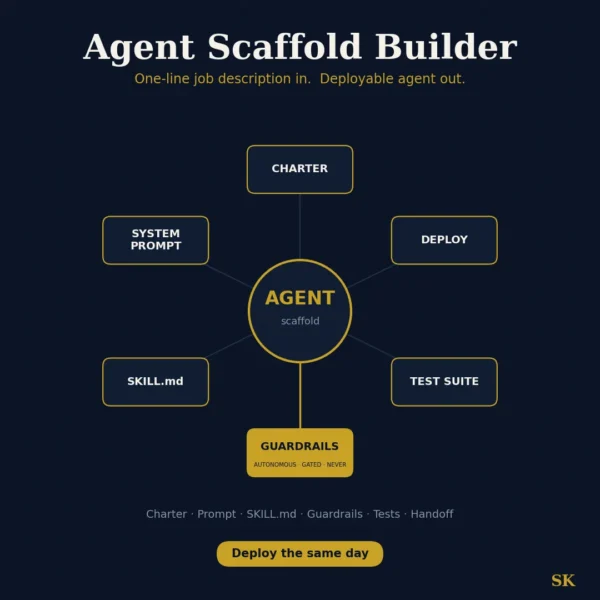
Agent Scaffold Builder
$8.99View skill
Skill · AI & Development
RAG Failure Diagnostics & Architect is a Claude skill for AI & Development. Diagnoses why a RAG system underperforms and architects the fix, with an evaluation harness and remediation plan. It costs $7 on Agensi. It runs on any paid Claude plan. Part of the StrategistKit catalog of 190+ focused Claude skills.
10 credits — included with a membership (30 credits/mo).
Prefer a one-time purchase, without joining?
Buy once on Agensi (opens in a new tab)StrategistKit Affiliate. One-time purchase on Agensi. Payment, delivery and refunds are handled by the marketplace — see their policy for refund terms.
Overview
This skill applies a structured debugging framework to RAG systems that return confident but wrong answers. You describe your setup — the corpus, chunking strategy, embedding model, retrieval pipeline, and a failing query or question type — and the skill classifies the failure first (retrieval miss, generation hallucination, structural incompatibility with vector search) before recommending anything. It operates in three modes: DIAGNOSE for a specific bad query, ARCHITECT for choosing the right retrieval shape for a given question type, and SCHEMA for designing the institutional-memory layer that embeddings permanently discard.
A typical input: 'Our RAG system answers questions about internal engineering decisions. When users ask why a particular architecture was chosen two years ago, it retrieves plausible documents but stitches together a confident, fabricated rationale. Chunking is paragraph-level, embeddings are OpenAI text-embedding-3-small, no reranker.' The skill identifies this as a causal-chain failure — the answer requires decision provenance, not semantic proximity — and routes it to DIAGNOSE and ARCHITECT modes rather than chunk-size tuning.
The output for that input would include: Failure mode — 'Causal/provenance miss: the rationale was never stored as a traversable relationship; top-k retrieval cannot reconstruct it.' Structural cause — 'Vector search flattens decision context into token proximity; reranking cannot recover what was never indexed.' Architect recommendation — 'Decision-provenance graph with typed edges (decision → option → rationale → author → date); plain RAG is a structural mismatch for this question class.' Remediation plan — ranked steps from schema design to query routing, with effort estimates and the explicit 80% boundary where tuning alone would stop helping.
Who it's for
ML engineers and AI architects who built a RAG system that is underperforming in production and need to know whether the problem is tunable or structurally wrong. Also useful for technical leads scoping a new retrieval system who want to avoid defaulting to pure vector search for question types it cannot reliably answer.
What you get
One .skill bundle. Run it on your material and it returns:
How it works
Add the .skill file to your Claude app. About 10 seconds.
Invoke the skill and paste in your material.
Review, keep what works, and use it.
In depth
A copy-paste prompt runs one static pass and stops. A skill is a bundled program — instructions, examples, and a workflow Claude runs as a unit: it asks for the right input, applies the same pattern every time, and returns the structured outputs above.
FAQ
Describe your retrieval pipeline (corpus type, chunking approach, embedding model, any reranker or hybrid search in use) and give at least one concrete failing query with the wrong answer it returned. The more specific the failure description, the more targeted the diagnosis.
No — the skill explicitly classifies the failure before recommending any parameter tuning. If the query requires multi-hop reasoning, temporal ordering, causal explanation, or aggregation, the skill names that as a structural mismatch and recommends the appropriate retrieval architecture instead of tuning advice that cannot fix the root cause.
It designs a harness matched to your failure mode: for retrieval failures it specifies recall metrics against a labeled query set; for generation failures it specifies faithfulness checks against retrieved context. It does not produce runnable code, but it produces the test design, metric selection, and labeling criteria you hand to an engineer to implement.
It covers the full decision space — vector RAG with hybrid search and reranking, knowledge graph and GraphRAG patterns, temporal and event-sourced indexes, structured query layers, and hybrid routers that dispatch by query type. It recommends the cheapest architecture that actually answers the question class, including cases where the right answer is a SQL query rather than RAG at all.
Yes. The ARCHITECT mode takes a question type or system description and maps it to the right retrieval shape, explaining what breaks if you default to pure vector search for that workload. The SCHEMA mode designs the institutional-memory layer for organizations that need agents to answer 'why' and 'what caused' questions that embeddings cannot support.
More in AI & Development
Part of these collections
We use cookies for anonymous analytics (read more). Accept, decline, or choose for yourself.