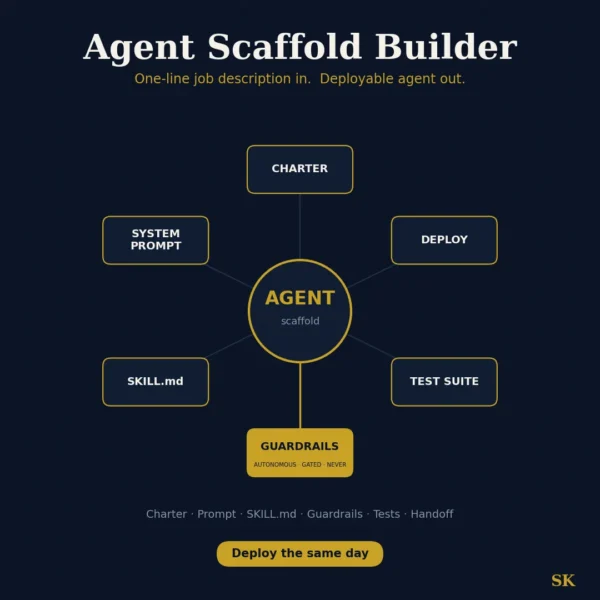
Agent Scaffold Builder
$8.99View skill
Skill · AI & Development
TDD Loop Master is a Claude skill for AI & Development. Enforce strict Red-Green-Refactor discipline to build robust software with 100% meaningful coverage. It's free on Agensi. It runs on any Claude plan, including Free. Part of the StrategistKit catalog of 190+ focused Claude skills.
10 credits — included with a membership (30 credits/mo).
Prefer a one-time purchase, without joining?
Get it free on Agensi (opens in a new tab)StrategistKit Affiliate. One-time purchase on Agensi. Payment, delivery and refunds are handled by the marketplace — see their policy for refund terms.
Overview
TDD Loop Master enforces the Red-Green-Refactor cycle as a strict gate system, not a suggestion. It opens every session by turning your requirement into a ranked test list — degenerate null cases first, complex edge cases last — before any code exists. From there it controls the pace: one failing test, the minimum production code to make it pass, then a refactor window only once the suite is green. It also audits any mocks you bring in, checking whether they could conceal a real failure.
A typical session starts with something like: 'I need to build a discount-calculation function in Python using PyTest. The rules are tiered by order value and customer status.' The skill asks four short context questions — stack, goal, constraints, audience — then generates the opening test list and writes the first forcing test in PyTest syntax, explaining exactly why it must fail before you touch production code.
The output for that first cycle might look like: Test List (excerpt): – [ ] calculate_discount(0, 'standard') returns 0.0 – [ ] calculate_discount(100, 'standard') returns 0.0 – [ ] calculate_discount(100, 'vip') returns 10.0 – [ ] calculate_discount(-1, 'standard') raises ValueError Red Phase — Forcing Test: def test_zero_order_returns_no_discount(): assert calculate_discount(0, 'standard') == 0.0 # Function does not exist yet — this must fail to proceed. Green Phase instruction: implement the narrowest code that passes only this assertion.
Who it's for
Software developers and engineering teams who want AI assistance that respects TDD discipline rather than generating untested code blocks — especially those working in Python, JavaScript, Java, or Go who have been burned by after-the-fact tests that mirror implementation rather than verify behaviour.
How it works
Add the .skill file to your Claude app. About 10 seconds.
Invoke the skill and paste in your material.
Review, keep what works, and use it.
In depth
A copy-paste prompt runs one static pass and stops. A skill is a bundled program — instructions, examples, and a workflow Claude runs as a unit: it asks for the right input, applies the same pattern every time, and returns the structured outputs above.
FAQ
At minimum, describe the feature or function you want to build and name your test framework (e.g. Jest, PyTest, JUnit, Go Test). The skill will ask four short follow-up questions to calibrate its output to your stack and constraints.
Both. For a bug fix, the skill first writes a failing test that reproduces the defect, then guides you through the minimum change to make it pass — ensuring the bug cannot silently regress.
It examines whether your mock substitutions could produce a passing test even if the real dependency were broken — a common source of false confidence. It flags those cases and suggests alternative designs or integration test boundaries.
No, and deliberately so. It writes the forcing test and specifies what the minimum passing implementation must achieve, but intentionally keeps production code suggestions minimal to prevent over-engineering before the next test drives the next requirement.
Yes. Bring your existing tests and the skill will audit them for tautology — identifying any test that cannot fail for a meaningful reason — then resume the Red-Green-Refactor loop from the correct point in your test list.
More in AI & Development
Part of these collections
We use cookies for anonymous analytics (read more). Accept, decline, or choose for yourself.