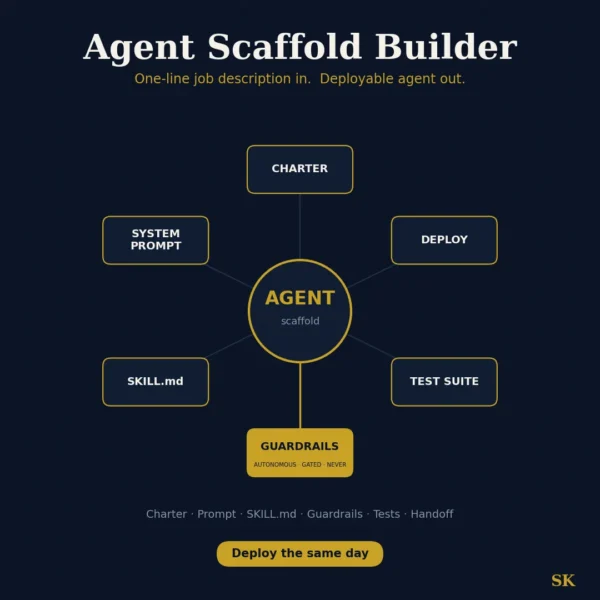
Agent Scaffold Builder
$8.99View skill
Skill · AI & Development
Systematic Bug Debugger is a Claude skill for AI & Development. Solve complex defects using hypothesis testing and root cause analysis instead of trial and error. It's free on Agensi. It runs on any Claude plan, including Free. Part of the StrategistKit catalog of 190+ focused Claude skills.
10 credits — included with a membership (30 credits/mo).
Prefer a one-time purchase, without joining?
Get it free on Agensi (opens in a new tab)StrategistKit Affiliate. One-time purchase on Agensi. Payment, delivery and refunds are handled by the marketplace — see their policy for refund terms.
Overview
The Systematic Bug Debugger imposes a structured diagnostic sequence on every defect you bring to it. Rather than proposing a fix immediately, it first establishes whether the bug can be triggered on demand, then maps your symptoms to specific architectural layers, ranks candidate causes by how well each explains the full evidence, and selects the single diagnostic step that eliminates the most hypotheses at once. A fix is only proposed after a root cause is confirmed, not guessed at.
A typical session starts with you pasting a stack trace, a short code excerpt, and a description of what makes the failure intermittent or environment-specific. The skill opens by asking four focused questions about your stack, the outcome you need, your constraints, and who will act on the findings. From there it drives the investigation through reproduction, bisection, and instrumentation before landing on a root cause with evidence.
Example output excerpt for a flaky integration test that fails only in CI: Hypothesis Ranking (highest to lowest likelihood): 1. Race condition on shared database fixture teardown — explains both the non-determinism and the CI-only pattern (CI parallelism = 4 workers, local = 1). 2. Environment variable POOL_SIZE absent in CI config — consistent with connection timeout trace on line 47. 3. Clock skew affecting token expiry — lower probability; timestamps in logs are consistent. Next diagnostic: add a per-test transaction rollback and re-run with –workers=4 locally. If failure disappears, hypothesis 1 is eliminated; if it reproduces, root cause is confirmed.
Who it's for
Backend and full-stack engineers who regularly face defects that resist quick fixes — intermittent test failures, bugs that vanish under a debugger, or production failures that cannot be reproduced locally. Also useful for engineering leads who want to instill a disciplined diagnostic process across a team rather than accepting speculative patches.
How it works
Add the .skill file to your Claude app. About 10 seconds.
Invoke the skill and paste in your material.
Review, keep what works, and use it.
In depth
A copy-paste prompt runs one static pass and stops. A skill is a bundled program — instructions, examples, and a workflow Claude runs as a unit: it asks for the right input, applies the same pattern every time, and returns the structured outputs above.
FAQ
At minimum: a description of the symptom, any stack trace or error message, and a small code snippet or description of the relevant code path. The more you can say about what makes the failure inconsistent — timing, environment, load — the more targeted the hypothesis ranking will be.
It walks through a diagnostic process. The skill is explicitly designed to resist proposing code changes until a root cause is confirmed. If you push for an immediate fix before that point, it will flag that doing so is a coin flip and explain why.
Concurrency bugs and intermittent failures are a primary use case. The skill includes specific workflows for non-deterministic behavior, race conditions, and flaky tests, including instrumentation tactics that do not disturb timing the way a standard debugger would.
Output adapts to your need. For an active debugging session it returns a ranked hypothesis list with a single recommended next diagnostic step. For a completed investigation it can produce a structured root-cause report with reproduction steps and a regression test specification you can hand to a colleague.
Yes. The diagnostic methodology — reproduction, symptom-to-layer mapping, bisection, instrumentation — applies regardless of language. You specify your stack in the opening context questions and the skill calibrates its advice, such as which logging APIs to use or how to isolate environment variables, to what you are actually running.
More in AI & Development
Part of these collections
We use cookies for anonymous analytics (read more). Accept, decline, or choose for yourself.