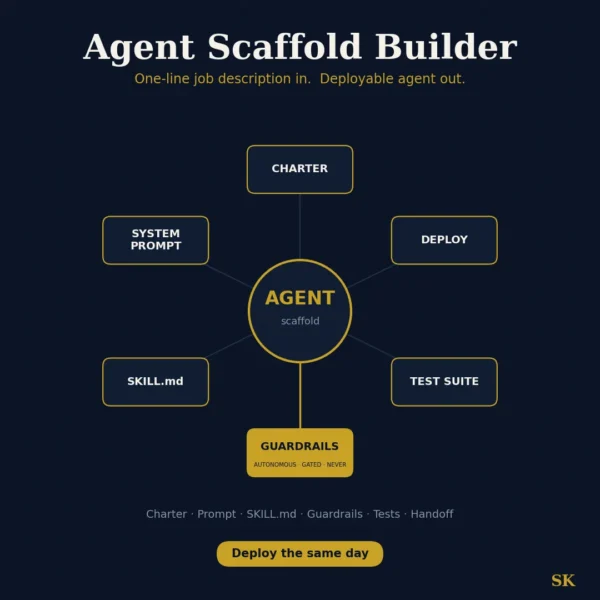
Agent Scaffold Builder
$8.99View skill
Skill · AI & Development
Schema Markup Generator is a Claude skill for AI & Development. Generate valid JSON-LD rich result markup and connected entity graphs tailored for Google Search eligibility. It costs $8.99 on Agensi. It runs on any Claude plan, including Free. Part of the StrategistKit catalog of 190+ focused Claude skills.
10 credits — included with a membership (30 credits/mo).
Prefer a one-time purchase, without joining?
Buy once on Agensi (opens in a new tab)StrategistKit Affiliate. One-time purchase on Agensi. Payment, delivery and refunds are handled by the marketplace — see their policy for refund terms.
Overview
Schema Markup Generator analyzes your page content or requirements, runs an eligibility check against current Google rich result criteria, then builds a single connected JSON-LD entity graph for that page — not a flat snippet, but properly nested types (Organization linked to WebSite, Offer nested inside Product, author entity tied to Article) with required and recommended properties filled in. It enforces content-markup parity before generating anything, so you are not shipping markup that could trigger a Search Console manual action.
You tell the skill your page type, share the relevant content (or describe it), and specify any stack constraints. For example: a product detail page on a headless Shopify build, with live price, two customer reviews averaging 4.6 stars, and an existing BreadcrumbList you want extended. The skill checks FAQ and HowTo eligibility status, selects the correct types for that page, and produces paste-ready JSON-LD.
Sample output excerpt for that product page — a structured block distinguishing required from recommended fields, plus a short validation checklist: { "@context": "https://schema.org", "@type": "Product", "name": "[product name]", "offers": { "@type": "Offer", "priceCurrency": "USD", "availability": "https://schema.org/InStock" }, "aggregateRating": { "@type": "AggregateRating", "ratingValue": "4.6", "reviewCount": "2" } } Validation steps: Rich Results Test > Search Console Enhancement report > monitor for warnings on aggregateRating.
Who it's for
Front-end developers and SEO specialists who need production-ready structured data fast and cannot afford 'missing field' warnings or ineligible markup types cluttering their codebase. Particularly useful when a site spans multiple page templates — product, article, local business, FAQ — each requiring a different entity graph.
How it works
Add the .skill file to your Claude app. About 10 seconds.
Invoke the skill and paste in your material.
Review, keep what works, and use it.
In depth
A copy-paste prompt runs one static pass and stops. A skill is a bundled program — instructions, examples, and a workflow Claude runs as a unit: it asks for the right input, applies the same pattern every time, and returns the structured outputs above.
FAQ
At minimum: the page type (e.g., Product, Article, LocalBusiness) and the visible content or a description of it — name, price, author, address, whatever is on the page. The more detail you provide, the more properties the skill can populate without guessing.
Yes. The eligibility check runs first. If a type you requested no longer earns a rich result under current Google guidelines, or if your content does not support the markup, the skill flags that before outputting any JSON-LD.
It produces one connected entity graph per page, which can include several linked types — for example, a Product with nested Offer, AggregateRating, and a BreadcrumbList — rather than isolated, unlinked blocks.
Paste-ready JSON-LD with a brief annotation distinguishing required from recommended properties, followed by a short validation workflow pointing to the Rich Results Test and the relevant Search Console enhancement report.
Yes. LocalBusiness markup — including geo-coordinates, opening hours, and service area — is a supported type, and the same eligibility-first approach applies.
More in AI & Development

Part of these collections
We use cookies for anonymous analytics (read more). Accept, decline, or choose for yourself.