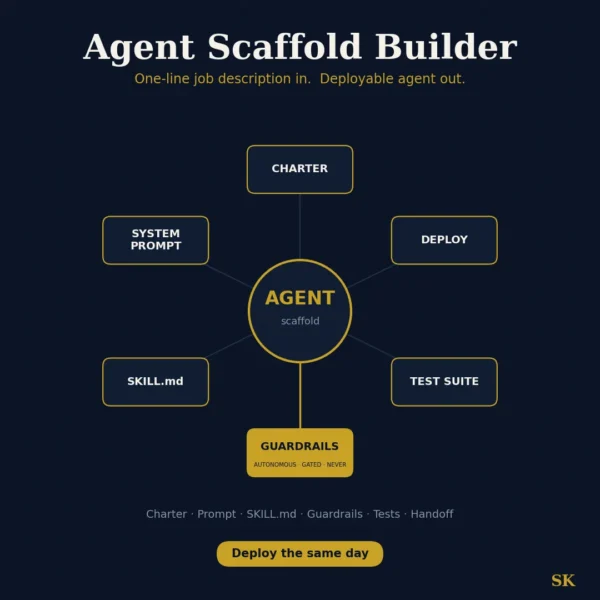
Agent Scaffold Builder
$8.99View skill
Skill · AI & Development
High-End Visual Redesigner is a Claude skill for AI & Development. Redesign generic UIs into premium brand experiences with professional CSS specs, typography scales, and luxury layouts. It costs $9.99 on Agensi. It runs on any Claude plan, including Free. Part of the StrategistKit catalog of 190+ focused Claude skills.
10 credits — included with a membership (30 credits/mo).
Prefer a one-time purchase, without joining?
Buy once on Agensi (opens in a new tab)StrategistKit Affiliate. One-time purchase on Agensi. Payment, delivery and refunds are handled by the marketplace — see their policy for refund terms.
Overview
High-End Visual Redesigner takes a site description and brand positioning as input, then works through a structured visual audit — anchoring every decision in the question a first-time visitor answers in three seconds: does this brand cost what it claims? It outputs a section-by-section redesign blueprint covering typography pairings with mathematical scale ratios, a restrained color system with specific HEX values, spacing and density rationale, imagery direction, and motion accents — all formatted so a developer or designer can move values directly into CSS or Figma without translation.
A buyer might paste in a URL and write: 'This is a fintech dashboard for wealth management clients. The current site looks like a Webflow template — busy gradients, five typefaces, no breathing room. We want it to feel like a private bank.' The skill first asks four context questions — stack, goal, constraints, audience — then produces a full visual direction grounded in that positioning. It leads with the single highest-impact change, not a list of everything at once.
Example output excerpt — Typography & Scale section: Display face: Canela Text (or GT Alpina as fallback). Body: Inter at 16px base, 1.6 line-height. Type scale: 1.333 ratio (perfect fourth). H1 capped at 56px on desktop; no heading above 44px on mobile. Avoid bold weights on display text — let size carry hierarchy, not weight. Assumption flagged: variable font support assumed; flag if IE11 compatibility is required.
Who it's for
Frontend developers and product designers who need to move a site from functional to premium-feeling but lack a senior art director to set visual direction. Also useful for solo founders or agency teams preparing a high-stakes rebrand pitch and needing implementation-ready specs rather than mood board concepts.
How it works
Add the .skill file to your Claude app. About 10 seconds.
Invoke the skill and paste in your material.
Review, keep what works, and use it.
In depth
A copy-paste prompt runs one static pass and stops. A skill is a bundled program — instructions, examples, and a workflow Claude runs as a unit: it asks for the right input, applies the same pattern every time, and returns the structured outputs above.
FAQ
At minimum: a description of your current site or a URL, and your brand's intended market positioning (e.g., 'affordable SaaS' vs. 'enterprise-only'). The skill will ask four short follow-up questions about your stack, goal, constraints, and target audience before producing its first recommendations.
Both. The skill produces narrative rationale alongside concrete implementable values — HEX codes, spacing units in rem or px, typeface names with scale ratios, and interaction timing values. You choose how much of each you need in the initial prompt or Steg 1 answers.
It adapts to whatever positioning and niche you supply at runtime. The visual logic is grounded in luxury and premium design principles that apply across industries — fintech, professional services, e-commerce, SaaS — not a single template aesthetic.
It covers the highest-impact sections by default — Hero, Social Proof, and Pricing blocks — with a full visual system that extends to other pages. If you need a specific section prioritised, state that in your context and it will lead there.
The output format adapts. You can request a structured spec document, a quick-answer bullet list, or a copy-paste ready checklist depending on your workflow. If you do not specify, it defaults to a structured report with findings and actionable recommendations.
More in AI & Development
Part of these collections
We use cookies for anonymous analytics (read more). Accept, decline, or choose for yourself.