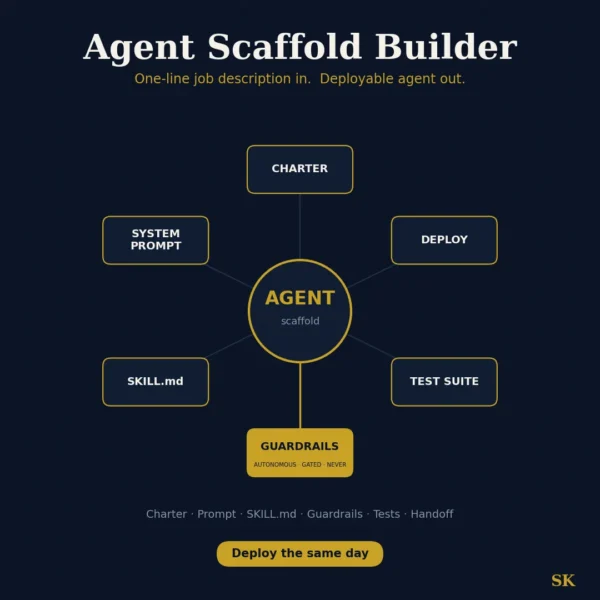
Agent Scaffold Builder
$8.99View skill
Skill · AI & Development
DevOps & SRE Playbook Suite is a Claude skill for AI & Development. Deploy SRE workflows, blameless postmortems, and SLO frameworks to improve system reliability and team response. It costs $12.99 on Agensi. It runs on any Claude plan, including Free. Part of the StrategistKit catalog of 190+ focused Claude skills.
10 credits — included with a membership (30 credits/mo).
Prefer a one-time purchase, without joining?
Buy once on Agensi (opens in a new tab)StrategistKit Affiliate. One-time purchase on Agensi. Payment, delivery and refunds are handled by the marketplace — see their policy for refund terms.
Overview
This skill covers the full SRE lifecycle in a single installation: blameless postmortems structured to drive behaviour change rather than blame, SLO and error budget frameworks tied to business impact, on-call runbooks built for 2am clarity, CI/CD pipeline risk audits, SAST configuration, and migration plans with staged rollback gates. Tell it your stack, team size, and current reliability maturity and it calibrates depth accordingly, then tells you precisely what to tackle next.
A typical session might start with: 'We had a database failover incident last night affecting 12,000 users. Stack is Kubernetes on GCP, team of eight engineers, no formal postmortem process yet.' The skill leads with the highest-impact action for that context, asks four short calibration questions, then produces a draft postmortem, a suggested SLO for the affected service, and a prioritised list of process gaps — ready to paste into your incident management system or engineering handbook.
Sample output excerpt (postmortem section): | Field | Content | | — | — | | Incident title | Database failover — 47-minute user-facing degradation | | Timeline | 02:14 alert fired; 02:31 root cause identified; 03:01 traffic restored | | Contributing factors | Missing read-replica promotion runbook; alert threshold set above SLO breach point | | Action items | 1. Write promotion runbook (owner: SRE lead, due: Friday) 2. Lower alert threshold to 99.5% over 5 min rolling window | | What went well | Rollback executed without data loss |
Who it's for
Engineering managers and SREs building or maturing a reliability practice — particularly those running small-to-mid-size teams without a dedicated platform org, who need production-ready postmortems, runbooks, and SLO definitions without starting from a blank page at 3am.
How it works
Add the .skill file to your Claude app. About 10 seconds.
Invoke the skill and paste in your material.
Review, keep what works, and use it.
In depth
A copy-paste prompt runs one static pass and stops. A skill is a bundled program — instructions, examples, and a workflow Claude runs as a unit: it asks for the right input, applies the same pattern every time, and returns the structured outputs above.
FAQ
At minimum: a description of your incident or the deliverable you need, your tech stack, and your team size. Maturity context (e.g. 'no formal on-call process yet') sharpens calibration further. The skill will prompt for anything missing before generating.
Outputs default to structured documents with summary, findings, and action items — designed to drop into incident management systems, Confluence, Notion, or a plain engineering handbook. It also produces copy-paste runbook templates and checklist formats with owner and timeline fields on request.
It covers ten distinct areas: incident classification, blameless postmortems, migration risk audits, changelog generation, SAST pipeline configuration, on-call runbooks, SLO and error budget design, deployment checklists, disaster recovery plans, and reliability metrics. You can work through one area per session or chain them.
Yes. The skill explicitly calibrates to maturity level. For early-stage teams it prioritises foundational quick-wins and explains the reasoning; for more mature organisations it goes deeper on error budget policy, SAST rule tuning, and multi-stage rollback gate design.
Stack-agnostic by design. You specify your tooling at the start of the session and all output — pipeline configs, runbook commands, SLO metric queries — references your actual environment rather than a generic example.
More in AI & Development
Part of these collections
We use cookies for anonymous analytics (read more). Accept, decline, or choose for yourself.