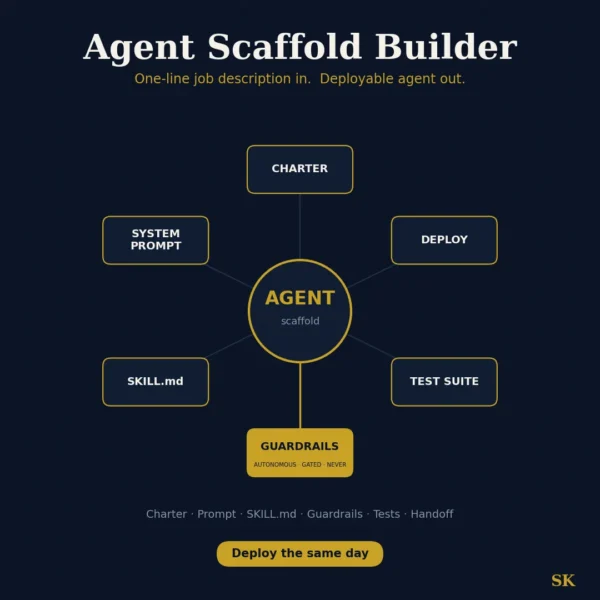
Agent Scaffold Builder
$8.99View skill
Skill · AI & Development
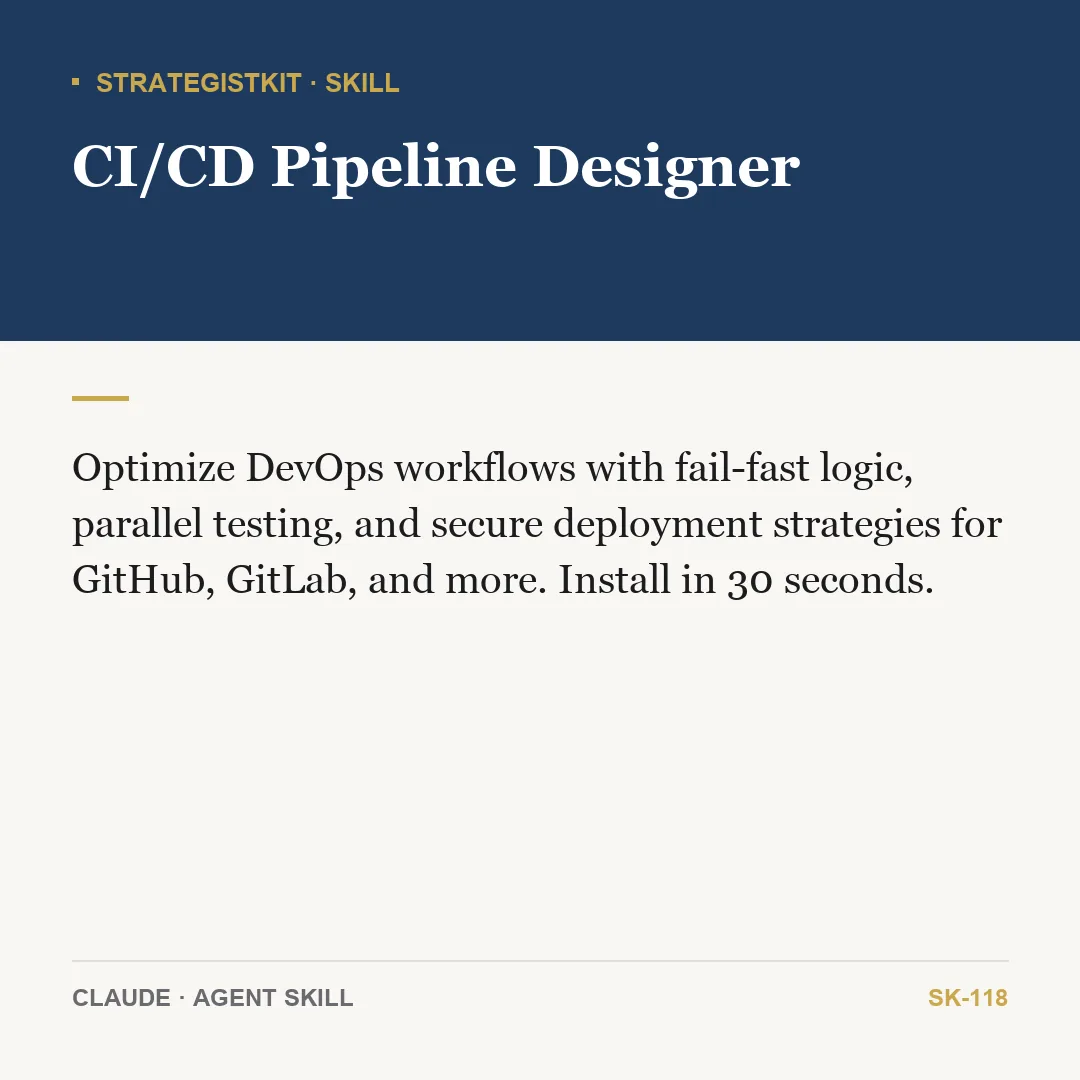
CI/CD Pipeline Designer is a Claude skill for AI & Development. Optimize DevOps workflows with fail-fast logic, parallel testing, and secure deployment strategies for GitHub, GitLab, and more. It costs $9.99 on Agensi. It runs on any Claude plan, including Free. Part of the StrategistKit catalog of 190+ focused Claude skills.
10 credits — included with a membership (30 credits/mo).
Prefer a one-time purchase, without joining?
Buy once on Agensi (opens in a new tab)StrategistKit Affiliate. One-time purchase on Agensi. Payment, delivery and refunds are handled by the marketplace — see their policy for refund terms.
Overview
CI/CD Pipeline Designer audits your existing delivery pipeline, identifies the stages consuming the most time and producing the least signal, and returns a prioritized roadmap to fix them. It applies cost-to-information ordering — cheap checks like linting and type analysis run before slow integration suites — so every failure surfaces at the earliest, cheapest point. It also designs flaky-test quarantine protocols, dependency caching strategies, deployment gates, and rollback triggers, all adapted to whichever CI platform and language stack you specify.
A buyer opens the skill and describes their situation: a Node.js monorepo on GitHub Actions where the full pipeline takes 22 minutes, three tests fail non-deterministically on every other run, and the team deploys manually to production because nobody trusts the pipeline. The skill asks four targeted questions about stack, goal, constraints, and audience, then produces a structured audit and action plan calibrated to that specific setup.
The output covers distinct modules: a bottleneck table ranking stages by duration and failure rate, a reordered stage sequence with rationale for each move, a caching configuration block for npm dependencies keyed to package-lock.json hash, a quarantine job definition that isolates the three flaky tests without blocking the main build, and a canary deployment template with automatic rollback triggers based on error-rate thresholds. Each section is copy-paste ready or formatted as a checklist with owner and verification fields, depending on the output format chosen.
Who it's for
Backend and full-stack developers who own or maintain a CI/CD pipeline that is too slow, too noisy, or too risky to deploy from confidently. Also useful for DevOps engineers tasked with standardizing pipelines across teams without the time to consult on every project individually.
How it works
Add the .skill file to your Claude app. About 10 seconds.
Invoke the skill and paste in your material.
Review, keep what works, and use it.
In depth
A copy-paste prompt runs one static pass and stops. A skill is a bundled program — instructions, examples, and a workflow Claude runs as a unit: it asks for the right input, applies the same pattern every time, and returns the structured outputs above.
FAQ
At minimum: your CI platform (GitHub Actions, GitLab CI, CircleCI, Jenkins, or Bitbucket Pipelines), your language stack, and a description of the specific problem — slow builds, flaky tests, deployment risk, secrets handling, or all of the above. The more detail you supply about current stage durations and failure patterns, the more precise the recommendations.
Both, depending on what you ask for. It can return copy-paste-ready workflow YAML blocks, structured audit reports with prioritized findings, annotated checklists, or plain direct answers. Specify your preferred output format or let it default to the most appropriate format for the task.
It handles both. If you are designing from scratch, it will ask about your stack and deploy targets and return a stage-ordered starting template. If you have an existing pipeline, it audits what you have and outputs a concrete improvement roadmap.
Yes. Blue-green deployments, canary releases with incremental traffic shifting, automatic rollback triggers based on error-rate or health-check thresholds, and environment-gated approval steps are all within scope, adapted to your cloud provider and platform.
It audits how secrets are referenced in your pipeline — checking for hardcoded values, overly broad secret scopes, and unsafe injection patterns — and recommends platform-native secrets management or external vault integration appropriate to your setup. Dependency pinning and lockfile hygiene are also covered.
More in AI & Development
Part of these collections
We use cookies for anonymous analytics (read more). Accept, decline, or choose for yourself.