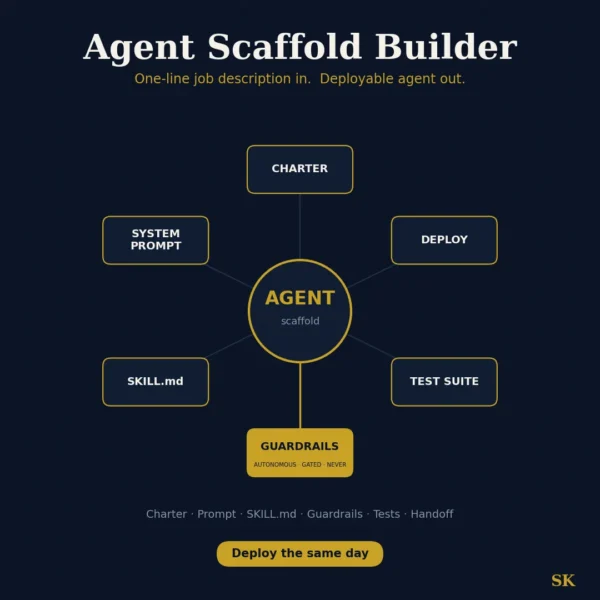
Agent Scaffold Builder
$8.99View skill
Skill · AI & Development
API Contract Designer is a Claude skill for AI & Development. Design consistent, production-ready REST and GraphQL contracts with OpenAPI specs. It costs $9.99 on Agensi. It runs on any Claude plan, including Free. Part of the StrategistKit catalog of 190+ focused Claude skills.
10 credits — included with a membership (30 credits/mo).
Prefer a one-time purchase, without joining?
Buy once on Agensi (opens in a new tab)StrategistKit Affiliate. One-time purchase on Agensi. Payment, delivery and refunds are handled by the marketplace — see their policy for refund terms.
Overview
API Contract Designer works by asking four scoping questions first — your domain, stack, desired output type, and who will consume the result — then proceeds through a fixed sequence of design decisions: resource modeling, naming conventions, error envelopes, pagination strategy, versioning, auth patterns, idempotency, webhooks, and an OpenAPI skeleton. Every cross-cutting decision is locked down once so no individual endpoint diverges. The skill adapts its output to your requested format: structured audit report, copy-paste OpenAPI YAML, or a prioritized checklist.
A typical input: a developer building a multi-tenant SaaS platform tells the skill they need a REST API for an order management domain, targeting third-party integrators, using Node.js, with cursor-based pagination and OAuth 2.0. They want a copy-paste OpenAPI skeleton plus an idempotency audit.
The skill would return a resource map (Order, LineItem, Fulfillment with lifecycle states), a locked error envelope schema, cursor pagination parameters, an Idempotency-Key header contract with retry semantics for POST /orders, and an OAS 3.1 skeleton with path stubs, component schemas, and security scheme definitions — structured so a developer can open it directly in Swagger Editor or Stoplight.
Who it's for
Backend and full-stack developers, API platform teams, and technical leads who need a consistent, reviewable API contract before implementation begins — particularly those handing off specs to external integrators, mobile clients, or other internal teams where breaking changes are costly.
How it works
Add the .skill file to your Claude app. About 10 seconds.
Invoke the skill and paste in your material.
Review, keep what works, and use it.
In depth
A copy-paste prompt runs one static pass and stops. A skill is a bundled program — instructions, examples, and a workflow Claude runs as a unit: it asks for the right input, applies the same pattern every time, and returns the structured outputs above.
FAQ
It produces four types depending on what you ask for: structured audit reports with findings and recommendations, copy-paste OpenAPI 3.x YAML skeletons, direct answers with bullet-point summaries, or action checklists. You specify the format in your initial input or let the skill default based on your request type.
Both are supported. You tell the skill which architectural style you are working in during the scoping step, and it adjusts its resource modeling, schema design, and output conventions accordingly. For GraphQL it focuses on type definitions, query/mutation naming, and resolver contracts rather than HTTP verbs and paths.
At minimum: a description of your domain (what the API is for), who will consume it, and what you want back (audit, spec, plan). Stack details and constraints improve the specificity of naming conventions, auth recommendations, and the OAS skeleton. If you skip any of these, the skill proceeds with documented defaults.
Yes. Tell the skill you want an audit report and paste in your existing endpoint list, schema fragments, or OpenAPI file. It will evaluate consistency, flag non-idempotent operations, identify missing error handling, and produce a prioritized set of findings with recommendations.
It generates a production-ready skeleton: all paths stubbed, component schemas defined, security schemes declared, and standard response shapes filled in. Request and response bodies are modeled from your domain inputs, but business-logic-specific field validation and example values require your review before the spec is final.
More in AI & Development
Part of these collections
We use cookies for anonymous analytics (read more). Accept, decline, or choose for yourself.