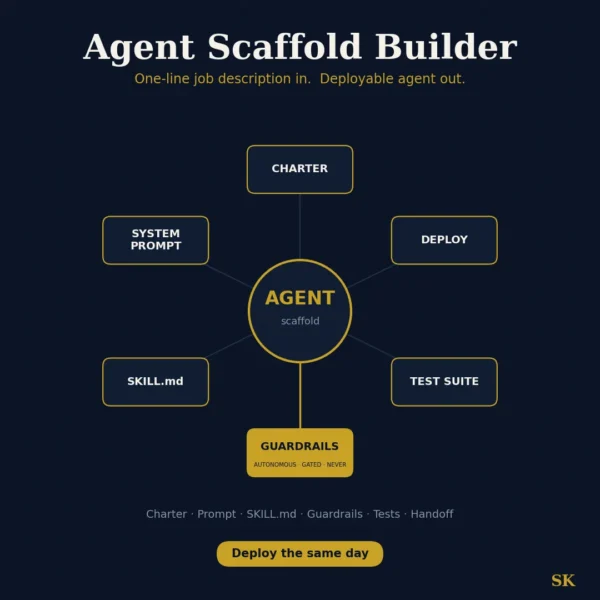
Agent Scaffold Builder
$8.99View skill
Skill · AI & Development
Accessibility Auditor is a Claude skill for AI & Development. Get expert WCAG 2.2 audits with production-ready code fixes prioritized by user impact to ensure deep accessibility compliance. It costs $9.99 on Agensi. It runs on any Claude plan, including Free. Part of the StrategistKit catalog of 190+ focused Claude skills.
10 credits — included with a membership (30 credits/mo).
Prefer a one-time purchase, without joining?
Buy once on Agensi (opens in a new tab)StrategistKit Affiliate. One-time purchase on Agensi. Payment, delivery and refunds are handled by the marketplace — see their policy for refund terms.
Overview
Accessibility Auditor works by simulating how real assistive technology users interact with your UI before it ever reads your code. It walks the keyboard path tab-by-tab, reviews ARIA implementation against the 'no ARIA beats wrong ARIA' principle, checks color contrast ratios, and evaluates focus trapping in modals and overlays. Every finding is ranked by who gets locked out — not by criterion number — and each one ships with a stack-specific code fix ready to paste into your codebase.
You paste in a React checkout flow or a Vue modal component, specify your stack, tell it whether you need a stakeholder report or a developer checklist, and it works through keyboard navigation, focus order, label associations, error announcements, and screen reader flow in sequence. The output adapts to your audience: a structured audit report for compliance sign-off, or a tight developer checklist with owner fields and verification steps for the next sprint.
A typical finding excerpt looks like this — Finding #1 (Critical / Keyboard Blocker): 'Custom dropdown at line 47 receives no focus and is unreachable by keyboard. Fix: replace div[role=combobox] with native select or add tabindex=0 plus keydown handlers. Verification test: tab to the field in Chrome, confirm focus ring appears, activate with Enter, confirm options announced by NVDA.' Every finding in the report follows the same structure: severity, explanation, code fix, and a manual test step to confirm it works with real assistive technology.
Who it's for
Front-end and full-stack developers preparing a product for WCAG 2.2 compliance, EAA regulatory requirements, or an internal accessibility review — and QA engineers or accessibility leads who need structured, impact-ranked audit reports they can hand directly to a development team.
How it works
Add the .skill file to your Claude app. About 10 seconds.
Invoke the skill and paste in your material.
Review, keep what works, and use it.
In depth
A copy-paste prompt runs one static pass and stops. A skill is a bundled program — instructions, examples, and a workflow Claude runs as a unit: it asks for the right input, applies the same pattern every time, and returns the structured outputs above.
FAQ
Paste in the component code, page HTML, or describe the UI flow you want audited. The skill opens by asking four short questions — your stack, your goal, any constraints, and who will read the output — so the findings are calibrated to your situation from the start.
Every finding includes a concrete code fix written for your tech stack (React, Vue, plain HTML/CSS, and others). It does not just cite the WCAG criterion — it tells you what line to change and what to change it to.
It adapts to your workflow: a structured report with summary, severity tiers, and recommendations for stakeholders; a developer checklist with owner and verification fields; or a quick-answer format for PR reviews. You specify the format, or it defaults based on what you ask.
Yes — that is its primary use case. Automated tools catch attribute-level issues like missing alt text. This skill simulates keyboard traversal and screen reader flow to find focus traps, unreachable custom components, incorrect ARIA patterns, and broken error announcements that static analysis cannot detect.
It is designed with EAA readiness in mind. The structured audit report format and impact-ranked findings map to the documentation typically required for compliance sign-off, though final legal review remains your team's responsibility.
More in AI & Development
Part of these collections
We use cookies for anonymous analytics (read more). Accept, decline, or choose for yourself.