Guide
The 7 Best Claude Skills for Consultants in 2026
The best Claude skills for consultants in 2026 are the MECE Problem Solver, the Competitive Analysis Agent, the Pitch Deck Writer, the Board Report Generator, Proposal Pro, the Client Welcome & Onboarding Kit Builder and the Strategy Session Facilitator — seven skills that cover the deliverables a practice actually bills for: the issue tree, the landscape, the deck, the board report, the proposal, the onboarding kit and the workshop.
A consulting practice has two kinds of hours: the ones clients pay for, and the ones spent producing the artifacts that win and hold the engagement. Skills attack the second kind. The structure of a good proposal or board report doesn’t change client to client — so encode it once and spend your hours on the judgment only you can add. Current prices are on the skill cards at the bottom of this guide, and one of the seven is available free as a starter skill.
How to choose the right skill
Start where you lose the most unbilled hours, not where the tool looks most impressive:
- The problem is still vague — start with the MECE Problem Solver.
- You need the market picture fast — the Competitive Analysis Agent.
- The work ends in a room — the Pitch Deck Writer for the story, the Board Report Generator for directors.
- Proposals eat your evenings — Proposal Pro.
- You run workshops or onboard new clients every month — the Strategy Session Facilitator or the Client Welcome & Onboarding Kit Builder.
Framing and analysis
MECE Problem Solver: turn a messy client problem into a MECE issue tree
The thinking tool the rest of the stack sits on. Give it a messy client problem and it walks the decomposition to a clean, mutually-exclusive, collectively-exhaustive breakdown — the kind of issue tree that used to require a strategy-firm apprenticeship. Every downstream deliverable gets sharper when the breakdown underneath it is right. View the skill →
Competitive Analysis Agent: a structured competitive analysis for any market
Every engagement needs a landscape view, and most get a rushed one. This skill runs a structured competitive pass for any business, product or market — positioning, moats, gaps — that slots straight into a strategy memo or the appendix of a board report. View the skill →
Decks and board reports
Pitch Deck Writer: slide-by-slide pitch deck outline and copy
For the work that ends in a room. This skill builds a complete deck outline with slide-by-slide copy — argument first, slides second — so the deck carries the meeting instead of decorating it. Useful for your own business development and for clients raising money. View the skill →
Board Report Generator: board reports built around decisions and risk
Directors read reports in a particular order and with particular impatience. This skill structures your material the way boards consume it — decision items up front, risk framed against appetite, appendix discipline — and does it identically every quarter. For interim leaders and board advisors it is the fastest recurring win in this guide. View the skill →
Winning and onboarding clients
Proposal Pro: client proposals, quotes and service offers from your scoping notes
Proposals are the classic unbilled time sink: high stakes, always urgent, structurally identical. This skill takes your scoping notes and returns a proposal, quote or service offer built to close — problem framing, approach, staging, terms — so a same-day turnaround stops being heroic. View the skill →
Client Welcome & Onboarding Kit Builder: a complete welcome and onboarding kit (free starter skill)
Retention starts in week one. This builder produces the complete onboarding kit — welcome pack, expectations, cadence, intake forms — tailored at runtime to the service you name, consulting included. One run per service line, then it compounds quietly for years. It is also one of the starter skills you can pick for free (see below). View the skill →
Running workshops
Strategy Session Facilitator: plan a strategy workshop — sequence, exercises, timeboxes
Workshops fail in the design, not in the room. This skill plans the session — sequence, exercises, timeboxes, capture format — around your objective and participant mix, and gives you a repeatable facilitation pattern across clients. View the skill →
An engagement, skill by skill
Chain them in the order an engagement actually runs: the MECE Problem Solver to frame, the Competitive Analysis Agent to ground, Proposal Pro to win, the Client Welcome & Onboarding Kit Builder to start well, the Strategy Session Facilitator and the Board Report Generator to deliver, the Pitch Deck Writer when it has to land in a room. Because each is a bundled workflow rather than a prompt, the second engagement runs faster than the first — and the tenth feels like a system.
If you want the full consulting stack at once, the Consultant’s Strategy Kit collects 60 skills in one purchase; a membership suits advisors who prefer to add a skill per engagement. Current prices are on those pages.
Start with a free skill
Pick one of ten curated starter skills — we’ll send it to your inbox. The Client Welcome & Onboarding Kit Builder from this guide is one of the ten. Everyone on the list also gets one new free skill every month. Pick your free skill →
How to add a skill to Claude
In the Claude app (Mac, Windows or web). Go to Customize → Skills, click +, choose Create skill → Upload a skill, and upload the skill’s ZIP file. From then on the skill is available in any conversation.
One prerequisite: code execution has to be turned on. On Free, Pro and Max you’ll find it under Settings → Capabilities. On Team and Enterprise an owner enables both “Code execution and file creation” and “Skills” in the organisation settings.
More on how skills load, and how they differ from prompts, agents and plugins: how Claude skills work.
Keep reading
- Best Claude skills for marketers — for the demand-generation side of a practice.
- Browse all skills for consultants & coaches — the full collection.
- Business & Consulting category — every consulting skill in the catalog.
From the catalog
Skills mentioned in this guide.
MECE Problem Solver
Board Report Generator
Proposal Pro
Pitch Deck Writer
Strategy Session Facilitator
Competitive Analysis Agent
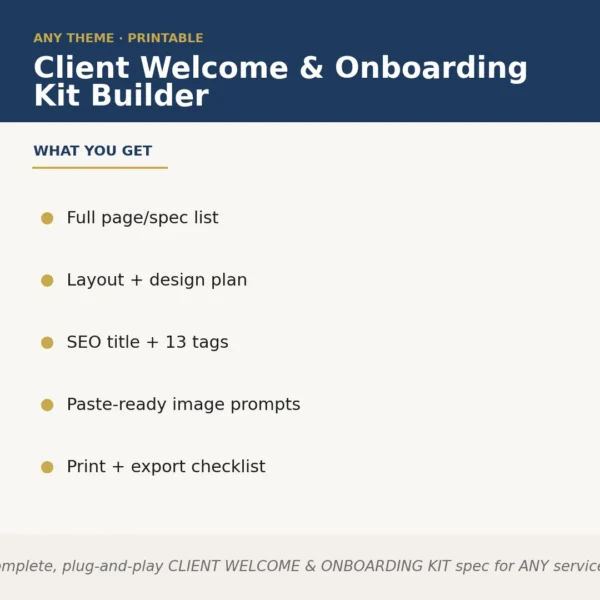
Client Welcome & Onboarding Kit Builder
FAQ
Frequently asked questions
Will clients notice the output came from an AI workflow?
The skills produce structure — the breakdown, the report skeleton, the proposal logic. Your judgment, client specifics and voice go on top. What clients notice is that the deliverable arrives faster and holds a consistent standard.
Which single skill should a solo consultant start with?
Start where you lose the most unbilled hours. For most solo advisors that is proposals — Proposal Pro pays for itself on the first one. If your bottleneck is analysis, start with the MECE Problem Solver instead.
Can I reuse one skill across very different client industries?
Yes — the engagement context is a runtime input. A MECE breakdown or board report structure works the same whether the client is a SaaS startup or a logistics firm; you supply the specifics each run.
Is there a cheaper way to get several of these at once?
Yes. The Consultant's Strategy Kit bundles 60 business and consulting skills in one purchase, and a StrategistKit membership covers several skills a month in credits. Both usually cost less per skill than buying singly — current prices are on the bundle and membership pages.
Do Claude skills work on the free plan?
Yes. Skills are available on Free, Pro, Max, Team and Enterprise. The only requirement is that code execution is enabled in your settings.
How do I install a Claude skill?
In the Claude app: Customize → Skills → + → Create skill → Upload a skill, then upload the ZIP. In Claude Code: place the skill folder in ~/.claude/skills/ or the project's .claude/skills/. Either way it takes seconds; code execution must be enabled.