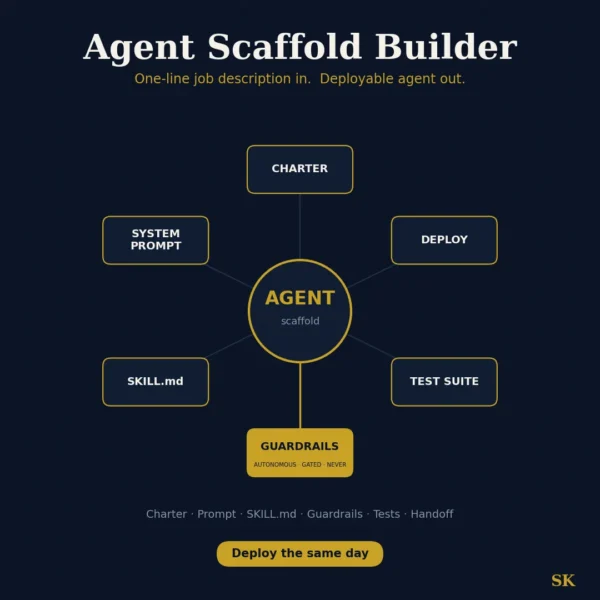
Agent Scaffold Builder
$8.99View skill
Skill · AI & Development
Technical Handoff Writer is a Claude skill for AI & Development. Extract tacit knowledge and load-bearing hacks into structured developer onboarding and handoff documents. It costs $8.99 on Agensi. It runs on any Claude plan, including Free. Part of the StrategistKit catalog of 190+ focused Claude skills.
10 credits — included with a membership (30 credits/mo).
Prefer a one-time purchase, without joining?
Buy once on Agensi (opens in a new tab)StrategistKit Affiliate. One-time purchase on Agensi. Payment, delivery and refunds are handled by the marketplace — see their policy for refund terms.
Overview
Technical Handoff Writer does not start writing when you describe your project — it starts asking questions. It runs a structured interview to surface the knowledge that never made it into your README: the service that silently fails when a specific env var is missing, the architectural decision that looks wrong but is holding everything together, the vendor quirk that took three incidents to understand. Once it has that context, it organizes the output around what the incoming developer needs in week one versus what they only need when something breaks at 2 AM.
A typical session begins with you describing your stack, who is taking over, and the timeline — for example, a backend engineer leaving a fintech team in four weeks, handing off a Node/Postgres API with a legacy payment retry queue that has undocumented behavior. The skill then asks targeted follow-up questions: What will the new hire try first that will not work? Which past decisions look like mistakes but must not be changed? Where are the credentials that are not in the vault?
From that interview, it produces sections including: a Gotchas and Load-Bearing Hacks block (e.g., 'The retry worker reads a hard-coded delay from a config file, not the environment — changing it in .env does nothing'), an Operational Runbook for the retry queue specifically, a Week-One Reading Path ordered by urgency rather than by system layer, a Gap Risk Assessment flagging which institutional knowledge still has no written owner, and an Access and Secrets Map listing every permission the new engineer needs before day one.
Who it's for
Engineers, tech leads, and engineering managers who are leaving a project, onboarding a replacement, or transferring ownership to another team — especially on codebases where the real operational knowledge lives in Slack history and muscle memory rather than in any document.
How it works
Add the .skill file to your Claude app. About 10 seconds.
Invoke the skill and paste in your material.
Review, keep what works, and use it.
In depth
A copy-paste prompt runs one static pass and stops. A skill is a bundled program — instructions, examples, and a workflow Claude runs as a unit: it asks for the right input, applies the same pattern every time, and returns the structured outputs above.
FAQ
It can output a full structured handoff document, a standalone operational runbook, a week-one onboarding track, or a gap risk assessment — depending on what you need. If you are short on time, it can also produce a prioritized checklist with owner fields.
No formal preparation is required. The skill opens with four questions covering your stack, your goal, your constraints, and who is receiving the output. If you are unsure about some answers, you can say so and it will proceed with reasonable defaults and flag its assumptions.
No. The skill is specifically designed to link to existing documentation rather than copy it. Its focus is the undocumented layer — decisions, workarounds, failure modes, and tribal knowledge that do not appear in any repo file.
Yes. During the interview phase you describe the scope, and the skill calibrates accordingly — it can scope a runbook to a single critical service or structure a broader knowledge transfer document across multiple components, with explicit notes on what is still undocumented.
It identifies specific areas where institutional knowledge has no written record and no clear owner — for example, a deployment step only one engineer knows, or a third-party integration whose contact history exists only in someone's inbox. It surfaces these as named risks so the outgoing team can decide whether to document them before the handoff closes.
More in AI & Development
Part of these collections
We use cookies for anonymous analytics (read more). Accept, decline, or choose for yourself.