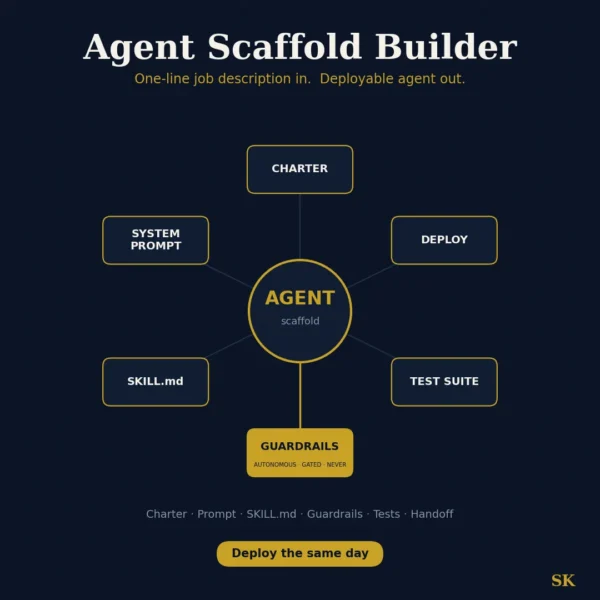
Agent Scaffold Builder
$8.99View skill
Skill · AI & Development
Security Audit & Compliance Toolkit is a Claude skill for AI & Development. Automate SAST code reviews, PII scanning, and GDPR compliance audits. It costs $12.99 on Agensi. It runs on any Claude plan, including Free. Part of the StrategistKit catalog of 190+ focused Claude skills.
10 credits — included with a membership (30 credits/mo).
Prefer a one-time purchase, without joining?
Buy once on Agensi (opens in a new tab)StrategistKit Affiliate. One-time purchase on Agensi. Payment, delivery and refunds are handled by the marketplace — see their policy for refund terms.
Overview
The toolkit runs a structured security pass across whatever you point it at — source code, API definitions, infrastructure configs, or architecture diagrams. It classifies scope first (SAST, PII/GDPR, dependency audit, or compliance gap), then works through OWASP Top 10 patterns, STRIDE threat boundaries, and the specific controls required by your chosen compliance framework. Every finding comes back ranked by severity and exploitability, paired with a concrete remediation step your engineers can act on without further research.
A typical session: you paste a Python Django REST API codebase and say 'audit for GDPR and SOC2, we process user health data.' The skill asks a few scoping questions — cloud provider, logging stack, third-party processors — then delivers a prioritised finding list. Sample output excerpt: CRITICAL — SQL injection via unsanitised query parameter in /api/records (CWE-89); remediate with parameterised queries, example provided. HIGH — SSN values present in application error logs (GDPR Art. 32 breach risk); remediate by stripping sensitive fields from log serialisers. MEDIUM — DPA not documented for SendGrid processor (GDPR Art. 28).
Who it's for
Engineers and CTOs running pre-launch security reviews, compliance officers preparing for SOC2 or ISO 27001 audits, and developers doing pre-pentest groundwork who need a ranked, actionable finding list rather than a raw linter report. Particularly useful for small teams without a dedicated security function.
How it works
Add the .skill file to your Claude app. About 10 seconds.
Invoke the skill and paste in your material.
Review, keep what works, and use it.
In depth
A copy-paste prompt runs one static pass and stops. A skill is a bundled program — instructions, examples, and a workflow Claude runs as a unit: it asks for the right input, applies the same pattern every time, and returns the structured outputs above.
FAQ
At minimum: the code, config, or architecture artifact you want audited, your tech stack (language, framework, cloud provider), and your compliance target (GDPR, SOC2, HIPAA, ISO 27001, or none). If you skip any of these, it will ask conversationally before proceeding.
Findings are returned as a ranked list with severity label (Critical/High/Medium/Low), the specific vulnerability or compliance gap, the CWE or regulatory reference, and a remediation step with code example where applicable. It is structured for direct handoff to an engineering backlog, not for executive reading.
Yes. You specify the compliance target at runtime. The skill adjusts its control checklist accordingly — SOC2 Trust Service Criteria, ISO 27001 Annex A controls, HIPAA technical safeguards, or GDPR Articles. You can also request a multi-framework gap assessment in a single session.
No. This is a reasoning-based static review — it reads what you provide and reasons about data flow, trust boundaries, and attacker paths without executing anything. For dependency CVE lookups it will tell you which tool to run (npm audit, pip-audit, etc.) and how to interpret the results, but does not run those tools itself.
Yes, it complements automated scanners rather than replacing them. Linters flag syntax-level patterns; this skill reasons about data flow across components, attacker motivations, and compliance obligations — things that require contextual understanding of your specific stack and threat model.
More in AI & Development
Part of these collections
We use cookies for anonymous analytics (read more). Accept, decline, or choose for yourself.