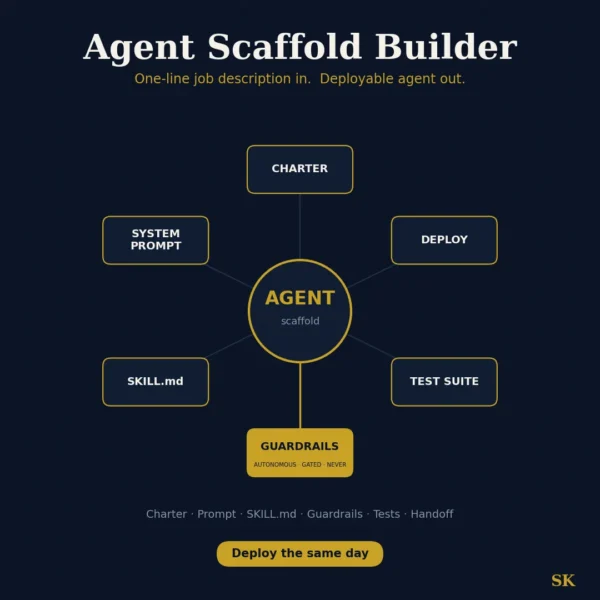
Agent Scaffold Builder
$8.99View skill
Skill · AI & Development
Redis Cache Architect is a Claude skill for AI & Development. Architect high-performance Redis layers with robust invalidation strategies, TTL design, and stampede protection. It costs $8.99 on Agensi. It runs on any Claude plan, including Free. Part of the StrategistKit catalog of 190+ focused Claude skills.
10 credits — included with a membership (30 credits/mo).
Prefer a one-time purchase, without joining?
Buy once on Agensi (opens in a new tab)StrategistKit Affiliate. One-time purchase on Agensi. Payment, delivery and refunds are handled by the marketplace — see their policy for refund terms.
Overview
Redis Cache Architect opens by asking the invalidation question before touching a single TTL: for each data type in your app, how stale is acceptable, and what event makes it wrong? From your answers it works through cacheability scoring (read/write ratio, update frequency, cost-to-serve), key namespace design with version prefixes that survive service boundary collisions, pattern selection across cache-aside, write-through, and read-through, TTL values with jitter to prevent synchronized expiry, stampede and thundering-herd mitigations, hot-key handling, memory policy choices, and what your app actually does when Redis goes down.
A typical session starts with a developer describing a Node/PostgreSQL e-commerce backend where product-listing queries take 800ms under load, catalog data changes a few times per day, cart data changes constantly, and Redis is currently used only for sessions. The skill immediately flags cart data as a poor cache candidate given its write frequency, then asks about the catalog update event — database trigger, admin CMS save, or batch import — before proposing any TTL.
The output for that session might look like this: Cacheability verdict — product listings: cache (read:write ~200:1, staleness tolerance 5 min); cart contents: do not cache (write-heavy, correctness-critical). Invalidation strategy — catalog uses event-driven delete-on-publish via CMS webhook; no polling. Key scheme — `catalog:v2:listing:{category_slug}:{page}`. Stampede protection — probabilistic early recompute at 80% TTL, mutex lock for cold-start. Redis-down behaviour — fall through to Postgres with circuit breaker; alert on miss-rate spike above 15%.
Who it's for
Backend and full-stack developers who have added Redis to a production app but are facing stale data incidents, memory pressure, or cache stampedes under traffic spikes. Also useful for engineers inheriting an existing Redis setup that lacks a coherent invalidation or key-naming strategy.
How it works
Add the .skill file to your Claude app. About 10 seconds.
Invoke the skill and paste in your material.
Review, keep what works, and use it.
In depth
A copy-paste prompt runs one static pass and stops. A skill is a bundled program — instructions, examples, and a workflow Claude runs as a unit: it asks for the right input, applies the same pattern every time, and returns the structured outputs above.
FAQ
Describe your app's stack, the specific queries or data types you want to cache, how often that data is written or updated, and any pain points you are already experiencing — stale reads, memory evictions, latency spikes. The more concrete your write-frequency and staleness-tolerance numbers, the more precise the recommendations.
It works at the architecture level and applies to any Redis 6+ deployment, whether self-hosted, AWS ElastiCache, Redis Cloud, or Upstash. Where a feature is version-specific — such as Redis 7 sharded pub/sub for invalidation — it will note the requirement.
By default the skill returns a structured design document: a cacheability table, selected invalidation pattern per data type, TTL and jitter values, a key-naming scheme, and failure-mode behaviour. If you tell it you just need a quick checklist or a copy-paste Redis config snippet, it adapts accordingly.
Yes, and it treats that as the first decision, not an afterthought. Data with high write frequency, strict consistency requirements, or invalidation events that are hard to hook into is flagged as a net-negative cache candidate before any TTL work begins.
Both are valid entry points. For greenfield work it produces a full layered design. For an existing setup, describe your current key structure, TTL values, and the incidents you have seen; it will identify the specific gaps and recommend targeted fixes rather than a full rebuild.
More in AI & Development
We use cookies for anonymous analytics (read more). Accept, decline, or choose for yourself.