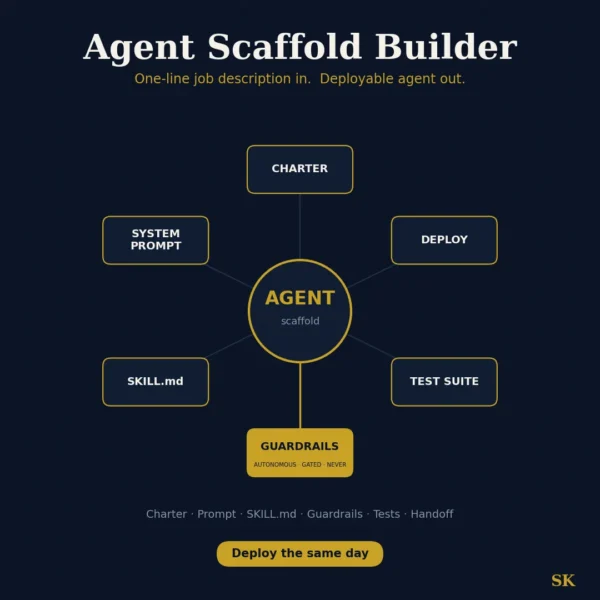
Agent Scaffold Builder
$8.99View skill
Skill · AI & Development
RAG Architecture & Debugging is a Claude skill for AI & Development. Diagnose and optimize RAG pipelines. It costs $9.99 on Agensi. It runs on any Claude plan, including Free. Part of the StrategistKit catalog of 190+ focused Claude skills.
10 credits — included with a membership (30 credits/mo).
Prefer a one-time purchase, without joining?
Buy once on Agensi (opens in a new tab)StrategistKit Affiliate. One-time purchase on Agensi. Payment, delivery and refunds are handled by the marketplace — see their policy for refund terms.
Overview
This skill runs a structured triage across three pipeline layers — ingestion, retrieval, and generation — to pinpoint exactly where a RAG system is breaking down. Supply your stack (embedding model, vector store, system type) and describe the symptom: wrong chunks returned, hallucinated answers, context overflow, slow latency. It maps the symptom to a failure layer using a diagnostic framework, then outputs a root-cause report with a prioritised remediation plan, specific architectural tradeoffs, and implementation steps — not generic advice.
A realistic input: 'I'm running a customer-support chatbot on Pinecone with text-embedding-3-small. Retrieval looks correct in logs but the model keeps hallucinating policy details. Token chunks are 512, no overlap, no re-ranker. Volume is ~8k documents, latency target under 2 seconds.' The skill identifies the layer, asks two clarifying questions if needed, and returns a structured plan.
Example output excerpt — Root-cause: generation layer. Prompt lacks explicit grounding instruction; model infers beyond retrieved context. Remediation (priority order): 1) Add 'answer only from the provided context; if unsure, say so' to system prompt. 2) Lower temperature to 0.2. 3) Switch to parent-child chunking: index 200-token chunks, return 800-token parent to LLM. 4) Add a cross-encoder re-ranker before prompt assembly to cut retrieval noise. Expected improvement: faithfulness score from ~0.65 to >0.85 on golden dataset.
Who it's for
Engineers and technical founders who have a RAG pipeline in production or in late-stage development and are hitting accuracy, hallucination, or performance problems they cannot easily isolate. Also useful for ML engineers designing a new system on Pinecone, Weaviate, pgvector, or Chroma who want architectural decisions made with explicit tradeoffs before touching code.
How it works
Add the .skill file to your Claude app. About 10 seconds.
Invoke the skill and paste in your material.
Review, keep what works, and use it.
In depth
A copy-paste prompt runs one static pass and stops. A skill is a bundled program — instructions, examples, and a workflow Claude runs as a unit: it asks for the right input, applies the same pattern every time, and returns the structured outputs above.
FAQ
At minimum: your vector store and embedding model, the system type (chatbot, search, knowledge base, etc.), and a description of what is going wrong or what you are trying to build. Scale details and sample queries improve the specificity of the output but are not required to start.
Both, depending on what you need. It returns architectural decisions with tradeoffs explained and prioritised remediation steps. Where a fix is straightforward — such as RRF scoring logic or a prompt grounding instruction — it includes the implementation directly. It does not generate a full codebase.
Yes. Tell it your system type, intended stack, data sources, and query pattern. It walks through the architecture decision framework — naive vs. advanced vs. modular vs. agentic RAG, hybrid vs. dense-only retrieval, chunking strategy — and recommends a starting configuration with the reasoning made explicit.
It covers the common production stacks: Pinecone, Weaviate, pgvector, and Chroma on the vector store side; OpenAI, Cohere, nomic-embed, and bge-series models on the embedding side. If you are using something else, describe it and the skill works from first principles.
It distinguishes between hallucination caused by retrieval failure (wrong or missing chunks) and hallucination caused by generation-layer issues (model going beyond the retrieved context). Each has a different fix. It asks you to log query, retrieved chunks, and final answer for a sample of queries, then traces which layer is the actual source of the problem.
More in AI & Development
Part of these collections
We use cookies for anonymous analytics (read more). Accept, decline, or choose for yourself.