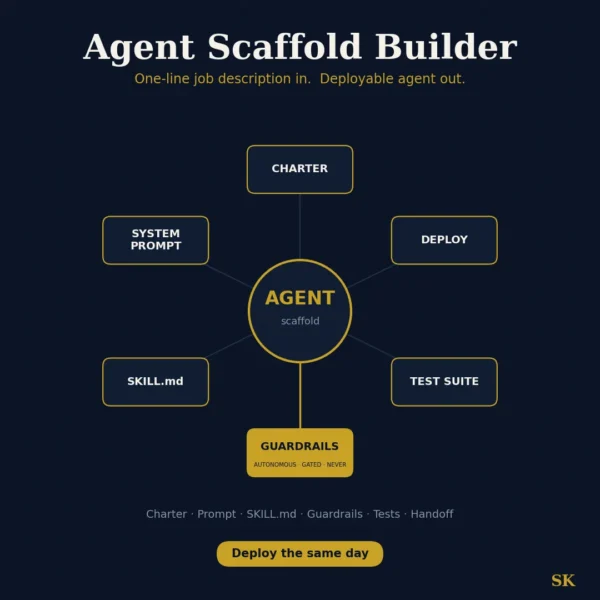
Agent Scaffold Builder
$8.99View skill
Skill · AI & Development
PRD to GitHub Issues is a Claude skill for AI & Development. Convert PRDs into structured GitHub issues with clear acceptance criteria, dependencies, and sizing. It costs $8.99 on Agensi. It runs on any Claude plan, including Free. Part of the StrategistKit catalog of 190+ focused Claude skills.
10 credits — included with a membership (30 credits/mo).
Prefer a one-time purchase, without joining?
Buy once on Agensi (opens in a new tab)StrategistKit Affiliate. One-time purchase on Agensi. Payment, delivery and refunds are handled by the marketplace — see their policy for refund terms.
Overview
This skill reads a product requirements document and decomposes it into a sequenced, estimable set of GitHub or Linear issues — one deliverable per ticket. It surfaces the work a PRD always omits: feature flags, migrations, instrumentation, rollback paths. Each issue comes out with a single-sentence scope, the context an engineer needs without re-reading the original spec, acceptance criteria written as observable behaviours you could demo, explicit blockers on other issues, and a size signal that flags which tickets need further breakdown before sprint planning.
You paste in your PRD — a Google Doc export, a Notion paste, or raw markdown — name your tracker, and describe your stack and team size. The skill asks four short clarifying questions before it starts, so the output reflects your constraints rather than generic defaults. If any section of the PRD is too vague to convert safely, the skill flags it explicitly and asks for clarification rather than converting ambiguity into a ticket.
A typical output excerpt for a payment-flow feature might look like: Issue 1 (S) — Add idempotency key column to payments table. Scope: schema migration only, no application logic. Acceptance criteria: column exists in production, backfill completes without downtime, rollback script tested. Blocks: Issues 3, 5. Issue 2 (M) — Implement idempotency check in charge endpoint. Depends on: Issue 1. Acceptance criteria: duplicate POST within 24 h returns cached response with original status code, not a new charge. The full output continues through every issue, grouped by milestone and ordered for parallel work where possible.
Who it's for
Product engineers and engineering managers who own the gap between a finished PRD and a sprint board — specifically anyone who has watched a feature spec become three sprawling tickets with no acceptance criteria and four engineers with four different understandings of done.
How it works
Add the .skill file to your Claude app. About 10 seconds.
Invoke the skill and paste in your material.
Review, keep what works, and use it.
In depth
A copy-paste prompt runs one static pass and stops. A skill is a bundled program — instructions, examples, and a workflow Claude runs as a unit: it asks for the right input, applies the same pattern every time, and returns the structured outputs above.
FAQ
Each issue is formatted as a titled block with scope, acceptance criteria, dependencies, and a size label. The default is markdown ready to paste into GitHub or Linear. If you specify a different tracker at the start, the skill adjusts field names and structure to match.
Paste the full PRD text — markdown, plain text, or a doc export all work. You will also be asked for your stack, team size, any hard constraints like timeline, and which tracker you use. The more context you give, the less generic the issue set.
The skill does not silently convert vague requirements into vague tickets. It identifies the ambiguous sections explicitly and asks you to clarify before proceeding. This is intentional — a ticket built on a fuzzy requirement causes more rework than a short clarification conversation.
Yes. The decomposition actively looks for omitted work: database migrations, rollback procedures, feature flag wiring, error states, instrumentation. These surface as distinct issues with their own scope and acceptance criteria, not as a footnote inside a larger ticket.
You specify your tracker when you start. The skill formats output for GitHub Issues by default but adjusts field labels and structure for Linear. For other trackers, describe the format you need and it will adapt.
More in AI & Development
Part of these collections
We use cookies for anonymous analytics (read more). Accept, decline, or choose for yourself.