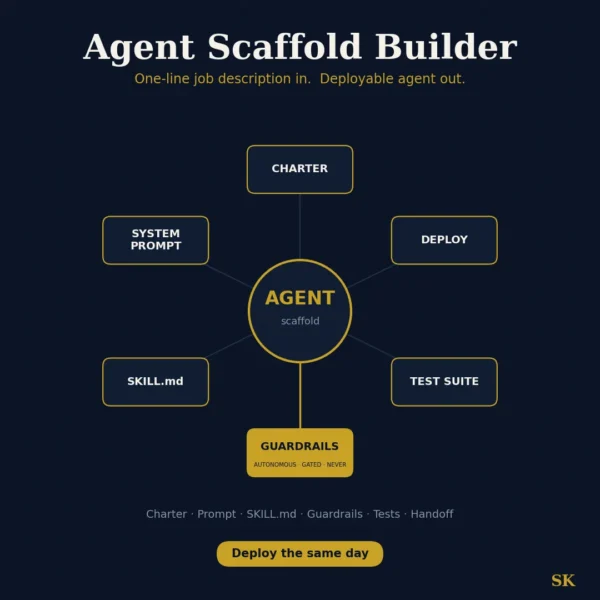
Agent Scaffold Builder
$8.99View skill
Skill · AI & Development
Open Source README Generator is a Claude skill for AI & Development. Generate high-conversion GitHub READMEs that explain your project in seconds. It costs $7.99 on Agensi. It runs on any Claude plan, including Free. Part of the StrategistKit catalog of 190+ focused Claude skills.
10 credits — included with a membership (30 credits/mo).
Prefer a one-time purchase, without joining?
Buy once on Agensi (opens in a new tab)StrategistKit Affiliate. One-time purchase on Agensi. Payment, delivery and refunds are handled by the marketplace — see their policy for refund terms.
Overview
This skill takes the raw facts about your project — what it does, who it is for, and what alternatives it competes with — and structures them into a README that answers the ten-second visitor question before asking for any setup investment. It leads with a one-sentence problem statement, follows with a working input/output example, places an honest comparison table ahead of the install block, and scales section depth to match the actual maturity of the project. A weekend side project does not get enterprise-grade governance sections.
A typical buyer session looks like this: you describe a CLI tool that converts OpenAPI specs to typed TypeScript clients, name Orval and openapi-generator as the tools most developers already know, and specify that your audience is TypeScript engineers who are tired of regenerating boilerplate. The skill asks four short clarifying questions — stack, current project stage, any constraints, intended reader — then produces the full README structure.
The output leads with: 'openapi-ts-gen turns an OpenAPI 3.1 spec into fully-typed TypeScript clients in one command — no Java runtime, no config file.' It follows immediately with a before/after code block showing a fetch call replaced by a generated typed method, then a two-column comparison of openapi-ts-gen versus Orval and openapi-generator on runtime dependencies, output style, and customisation surface. Installation appears after the reader is already convinced.
Who it's for
Open source maintainers who ship code faster than they write documentation, and developers preparing to launch or re-launch a repo who suspect a weak README is suppressing stars, forks, and contributors. Particularly useful when the project has real competitors and needs to make an honest case for itself rather than pretend alternatives do not exist.
How it works
Add the .skill file to your Claude app. About 10 seconds.
Invoke the skill and paste in your material.
Review, keep what works, and use it.
In depth
A copy-paste prompt runs one static pass and stops. A skill is a bundled program — instructions, examples, and a workflow Claude runs as a unit: it asks for the right input, applies the same pattern every time, and returns the structured outputs above.
FAQ
At minimum: what the project does in plain language, who the intended user is, and the one to three alternatives a typical visitor would already know. Stack and current maturity level sharpen the output further, but the skill will ask for anything missing rather than guess badly.
Honest alternatives comparison is a named section in the skill's structure. You supply the competitor names and any known differentiators; the skill formats them into a readable comparison and frames your project's position without dismissing or hiding the competition.
It includes a badge discipline section that adds only the badges with real signal — build status, license, latest version — and omits decorative ones. You supply the repo URLs; it formats the markdown.
The skill calibrates section depth to stated project maturity. A pre-release tool gets a lean structure focused on what it already does; sections like 'Roadmap' and 'Contributing' are sized down or restructured as honest placeholders rather than inflated promises.
The skill returns copy-paste ready GitHub Markdown. You get the full README text, not a brief or a plan, ready to drop into your repo's README.md.
More in AI & Development
Part of these collections
We use cookies for anonymous analytics (read more). Accept, decline, or choose for yourself.