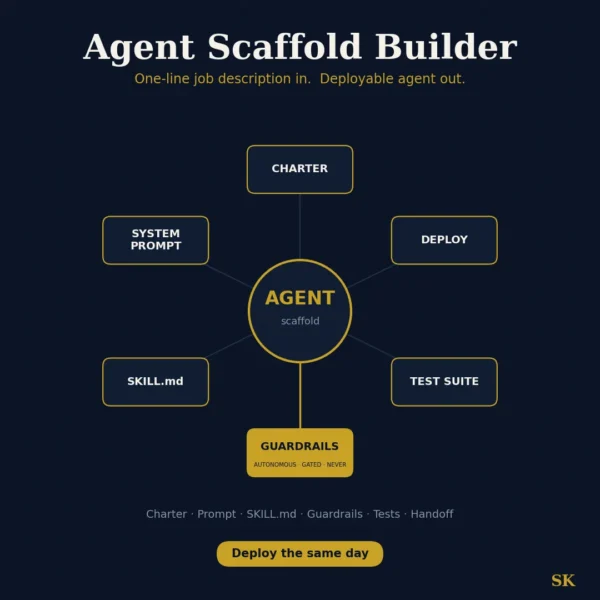
Agent Scaffold Builder
$8.99View skill
Skill · AI & Development
Mobile App Master is a Claude skill for AI & Development. Architect and launch high-performance apps with expert guidance on SwiftUI, Kotlin, and React Native. It costs $8.99 on Agensi. It runs on any Claude plan, including Free. Part of the StrategistKit catalog of 190+ focused Claude skills.
10 credits — included with a membership (30 credits/mo).
Prefer a one-time purchase, without joining?
Buy once on Agensi (opens in a new tab)StrategistKit Affiliate. One-time purchase on Agensi. Payment, delivery and refunds are handled by the marketplace — see their policy for refund terms.
Overview
Mobile App Master guides you through the full build cycle for iOS, Android, and cross-platform apps — from the first architecture decision through App Store submission. Tell it your platform (SwiftUI, Jetpack Compose, React Native, Flutter, or .NET MAUI), your target audience, and the features that matter most. It then designs the app structure, patterns offline sync and local-first data storage, specifies push notification and deep-link wiring, audits for the performance and security issues that most commonly trigger App Store rejections, and produces ASO metadata calibrated to your app category.
A realistic starting prompt: 'I'm building a React Native field-service app for Android and iOS. Technicians work in areas with no cell signal. Key features: job assignment, photo capture, parts lookup, digital sign-off. Small dev team, eight-week runway.' From that, the skill will ask four focused context questions — or proceed immediately on smart defaults if you say skip — then work through architecture, offline sync, and submission in the order that matters for your situation.
The structured output covers four artefacts: an Architecture Decision Record comparing local-first sync options and state management approaches for your stack; a screen-flow specification mapping each user path and transition; a submission checklist flagging privacy manifest requirements, entitlement declarations, and screenshot specs for every target store; and an ASO keyword strategy with primary and secondary terms ranked by relevance to your app's category and audience. Each section is scoped to what you specified — not generic mobile advice.
Who it's for
Indie developers and small product teams who are scoping or mid-build on a mobile app and need senior-level architecture, store-submission, and ASO guidance without a dedicated mobile specialist on staff. Also useful for technical founders who have shipped a v1 and need an honest audit before a public launch or platform review.
How it works
Add the .skill file to your Claude app. About 10 seconds.
Invoke the skill and paste in your material.
Review, keep what works, and use it.
In depth
A copy-paste prompt runs one static pass and stops. A skill is a bundled program — instructions, examples, and a workflow Claude runs as a unit: it asks for the right input, applies the same pattern every time, and returns the structured outputs above.
FAQ
SwiftUI, UIKit, Jetpack Compose, Kotlin, React Native, Flutter, and .NET MAUI. Tell it your stack at the start and all guidance — code patterns, state management, offline strategy — is specific to that framework.
It returns an Architecture Decision Record, a screen-flow specification, an App Store and Google Play submission checklist, and an ASO keyword strategy. Format can be adjusted — structured report, checklist with owner fields, or direct bullets — depending on how you say you'll use it.
Either works. Supply your platform, target audience, and planned features and it will design an architecture from scratch. If you have an existing codebase, describe its current state and it shifts into audit mode, identifying rejection risks and structural issues before you hit the store review queue.
The more detail you give on platform, audience, and key features, the more precise the output. If you say 'decide for me' or skip the context questions, the skill picks reasonable defaults and flags the assumptions so you can correct them.
Both are covered. Offline sync and local-first data patterns, push notification entitlement setup, and deep-link routing structures are explicit sections — not afterthoughts — because they account for a large share of post-v1 rewrites and store rejections.
More in AI & Development
Part of these collections
We use cookies for anonymous analytics (read more). Accept, decline, or choose for yourself.