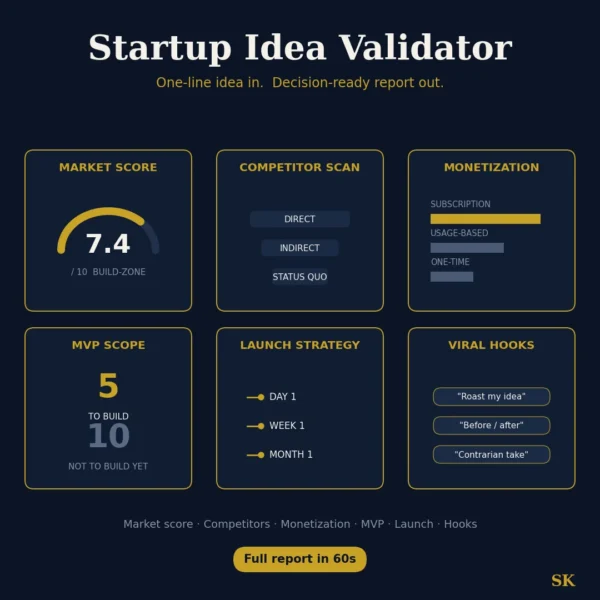
Startup Idea Validator
$8.99View skill
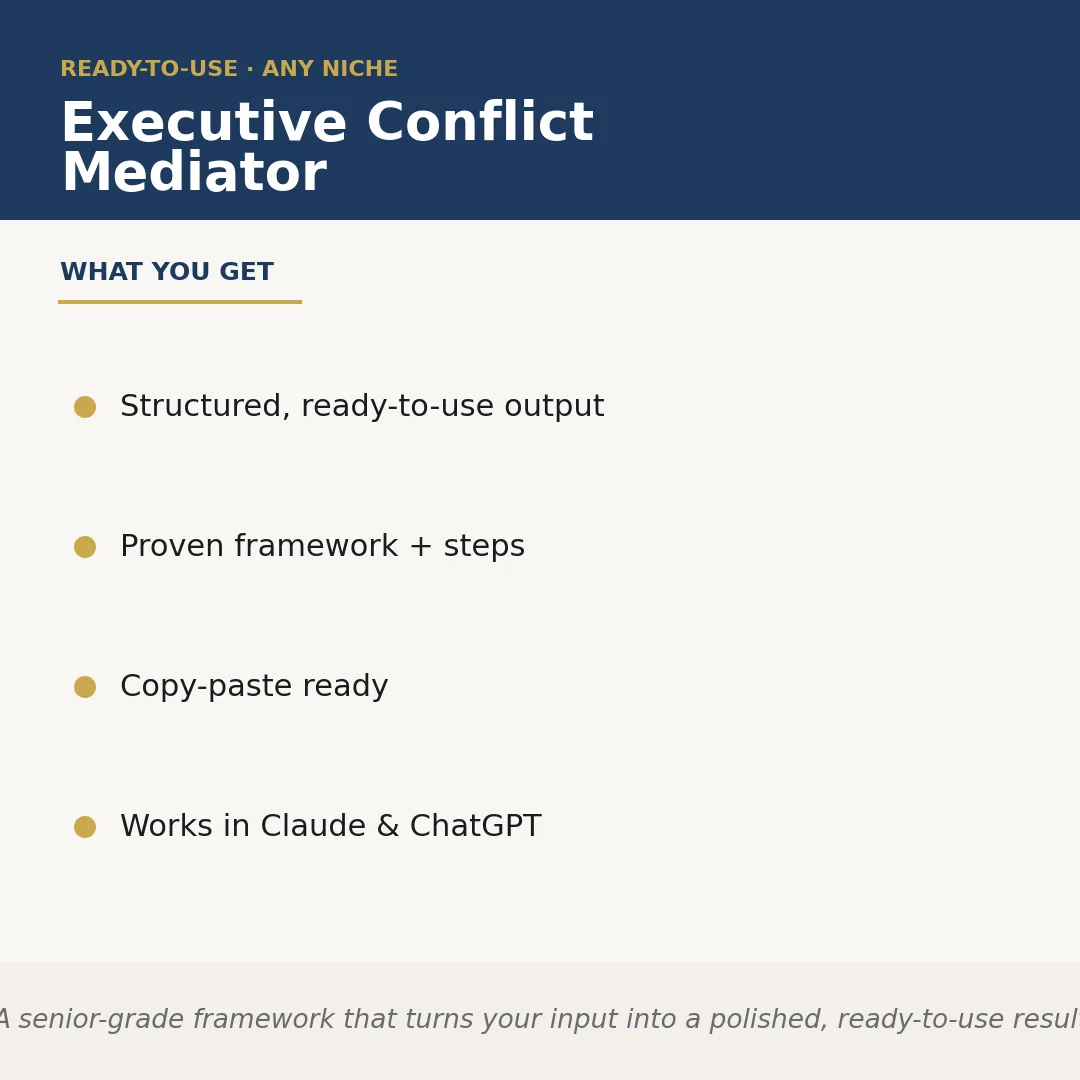
Skill · Business & Consulting
Executive Conflict Mediator is a Claude skill for Business & Consulting. A senior-grade framework that turns your input into a polished, ready-to-use result. It costs $5.99 on PromptBase. It runs on any Claude plan, including Free. Part of the StrategistKit catalog of 190+ focused Claude skills.
10 credits — included with a membership (30 credits/mo).
Prefer a one-time purchase, without joining?
Buy once on PromptBase (opens in a new tab) Also on Agensi — $8.99 (opens in a new tab)StrategistKit Affiliate. One-time purchase on PromptBase. Payment, delivery and refunds are handled by the marketplace — see their policy for refund terms. PromptBase purchases earn us a referral fee.
Overview
Executive Conflict Mediator takes a description of a real workplace dispute — between co-founders, department heads, board members, or senior stakeholders — and produces a structured mediation plan ready to act on. You supply the context: who is involved, what the conflict is about, what each party wants, and any relevant history. The skill applies a senior-level facilitation framework to diagnose the root dynamic, map each party's interests versus positions, and draft the language and sequence you need to move toward resolution.
Example input: 'Our CTO and VP of Product have been in open conflict for six weeks over technical roadmap ownership. The CTO wants to gate all feature specs through engineering. The VP of Product says that removes her mandate. The CEO has asked me to mediate before the next board meeting.' The skill processes that scenario and returns a phased mediation plan with pre-session talking points, a structured agenda, and suggested reframing language for each party.
Sample output excerpt — Mediation Plan: Phase 1 (Pre-session, individual): CTO talking point: 'What does technical accountability look like to you without slowing product velocity?' VP Product talking point: 'Where does engineering input feel most valuable versus most constraining?' Phase 2 (Joint session): Agenda item 1 — Shared definition of 'roadmap ownership.' Agenda item 2 — Decision-rights matrix draft. Phase 3 (Follow-up): Written agreement template with 30-day review trigger.
Who it's for
HR business partners, executive coaches, CEOs, and fractional COOs who need to facilitate high-stakes disputes between senior leaders quickly and without defaulting to generic conflict-resolution platitudes. Particularly useful when an outside mediator is not an option and the facilitator needs credible structure before stepping into a charged room.
What you get
One .skill bundle. Run it on your material and it returns:
How it works
Add the .skill file to your Claude app. About 10 seconds.
Invoke the skill and paste in your material.
Review, keep what works, and use it.
In depth
A copy-paste prompt runs one static pass and stops. A skill is a bundled program — instructions, examples, and a workflow Claude runs as a unit: it asks for the right input, applies the same pattern every time, and returns the structured outputs above.
FAQ
It returns a phased mediation plan that includes pre-session talking points tailored to each party, a structured joint-session agenda, reframing language to de-escalate positional fighting, and a follow-up agreement template. Everything is copy-paste ready for immediate use.
At minimum: the roles of the parties in conflict, a clear description of the dispute, each party's stated position, and the outcome you are trying to achieve. Adding relevant history or power dynamics improves the output significantly.
Yes. You can describe a multi-party dispute — such as a leadership team fractured across two factions — and the skill will adapt the framework to map multiple interest sets and sequence the mediation accordingly.
The skill works across any business context. You supply the niche and organizational details at runtime; the framework adapts to whether you are mediating a startup co-founder dispute, a corporate division conflict, or a nonprofit board disagreement.
This skill applies a structured interests-versus-positions diagnostic, generates party-specific language rather than generic advice, and sequences output into actionable phases — pre-session, joint session, and follow-up — rather than returning broad principles.
More in Business & Consulting
Part of these collections
We use cookies for anonymous analytics (read more). Accept, decline, or choose for yourself.