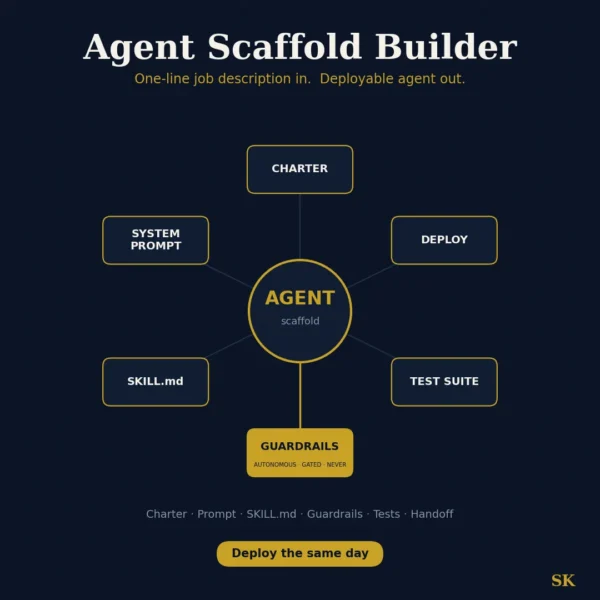
Agent Scaffold Builder
$8.99View skill
Skill · AI & Development
Developer Documentation Writer is a Claude skill for AI & Development. Write task-oriented developer docs, API references, and quickstarts that software engineers actually use. It costs $8.99 on Agensi. It runs on any Claude plan, including Free. Part of the StrategistKit catalog of 190+ focused Claude skills.
10 credits — included with a membership (30 credits/mo).
Prefer a one-time purchase, without joining?
Buy once on Agensi (opens in a new tab)StrategistKit Affiliate. One-time purchase on Agensi. Payment, delivery and refunds are handled by the marketplace — see their policy for refund terms.
Overview
This skill takes what you know about your API or system and turns it into documentation structured the way developers actually read: task-first. You provide your API surface, endpoint behaviors, or system concepts; your target developer persona; and the top errors or sticking points your users hit. The skill returns an API reference organized around developer goals, a quickstart built to reach a working example fast, and a troubleshooting section grounded in real failure modes — not theoretical ones.
A realistic input looks like this: a webhook-based payment API whose existing docs are a flat list of endpoints, a target persona of backend engineers integrating for the first time, and three common points of confusion — authentication header format, idempotency key behavior, and handling retry payloads. The skill reorganizes the reference around integration tasks, writes a quickstart that ends with a verified test transaction, and produces a troubleshooting section with the exact error codes those engineers encounter.
Sample output excerpt — Quickstart section header structure: '1. Get your API key (2 min) — 2. Make your first authenticated request — 3. Handle your first webhook event — 4. Verify end-to-end in test mode.' Each step includes a minimal working code snippet, the expected response, and a single-sentence note on the most common mistake at that step. The reference entries follow the same pattern: goal stated first, parameters second, errors third.
Who it's for
Developer advocates, engineering leads, and technical writers who own docs for an API or developer platform and need output that engineers will actually consult instead of routing around. Also useful for early-stage teams shipping their first public API with no documentation baseline yet.
How it works
Add the .skill file to your Claude app. About 10 seconds.
Invoke the skill and paste in your material.
Review, keep what works, and use it.
In depth
A copy-paste prompt runs one static pass and stops. A skill is a bundled program — instructions, examples, and a workflow Claude runs as a unit: it asks for the right input, applies the same pattern every time, and returns the structured outputs above.
FAQ
At minimum: a description of your API or system, the developer persona you are writing for, and the top three things users get stuck on. Existing drafts, endpoint specs, or error logs improve the output but are not required.
Output is structured prose and code snippets organized into named sections — quickstart, API reference entries, conceptual overview, and troubleshooting. It is written for direct use in a docs site or developer portal; you copy, paste, and adjust rather than rewrite from scratch.
Yes. If you paste in existing documentation, the skill identifies structural problems — buried prerequisites, endpoint-first rather than task-first organization, missing error handling — and returns a reorganized, revised version alongside a brief note on what changed and why.
It works for any audience of software engineers: public APIs, internal platforms, SDKs, CLI tools, or infrastructure systems. The persona input is where you specify whether the reader is an external third-party developer or an internal engineer.
The skill adapts to whatever system you describe. The niche, language ecosystem, and developer context come from your input; there is no fixed domain baked in. A payment API, a data pipeline SDK, and an infrastructure CLI will each produce structurally different, contextually appropriate docs.
More in AI & Development
Part of these collections
We use cookies for anonymous analytics (read more). Accept, decline, or choose for yourself.