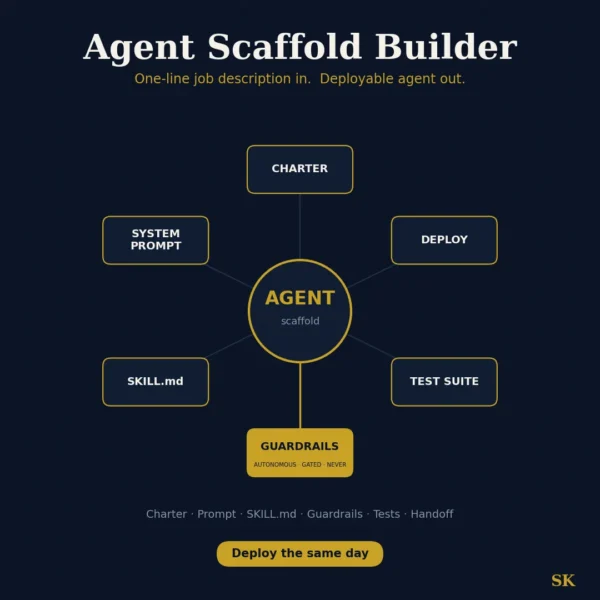
Agent Scaffold Builder
$8.99View skill
Skill · AI & Development
Design System Enforcer is a Claude skill for AI & Development. Audit UI debt, map hardcoded values to tokens, and eliminate component drift in your frontend codebase. It costs $9.99 on Agensi. It runs on any Claude plan, including Free. Part of the StrategistKit catalog of 190+ focused Claude skills.
10 credits — included with a membership (30 credits/mo).
Prefer a one-time purchase, without joining?
Buy once on Agensi (opens in a new tab)StrategistKit Affiliate. One-time purchase on Agensi. Payment, delivery and refunds are handled by the marketplace — see their policy for refund terms.
Overview
Design System Enforcer audits your frontend codebase by inventorying every real component variant and CSS value it finds, then classifying each deviation as an intentional variant, accidental drift, or a gap the design system itself never covered. It maps raw hex codes, hardcoded spacing, and rogue font sizes to your existing tokens, sequences consolidation by page traffic so high-impact fixes come first, and produces governance rules and lint-level enforcement configs to stop drift from returning.
To get started, share your stack context — for example: a Tailwind-based React app with a partial token set, 14 button variants found in production, and a Figma library that defines three. The skill then works through your components and token file, identifying which of those 14 buttons are safe to merge, which serve a genuine use case, and which exist because someone copy-pasted a component on a deadline.
A typical output excerpt looks like this — Variant Inventory (Button): 14 found in codebase / 3 defined in system. Classification: 3 intentional (primary, secondary, destructive), 2 accidental duplicates (btn-blue, btn-primary-v2 — map to 'primary'), 9 undocumented variants pending review. Hardcoded values flagged: #1D4ED8 appears 23 times — maps to token color.brand.600. Consolidation priority: Button (used on 47 routes) before DatePicker (used on 2). Proposed ESLint rule: no-hardcoded-color — block raw hex in className strings.
Who it's for
Frontend developers and design system leads who are inheriting or cleaning up a codebase where token coverage is incomplete and component variants have multiplied without governance. Also useful for solo developers preparing a component library for team handoff who need a structured audit before they write the contributing guide.
How it works
Add the .skill file to your Claude app. About 10 seconds.
Invoke the skill and paste in your material.
Review, keep what works, and use it.
In depth
A copy-paste prompt runs one static pass and stops. A skill is a bundled program — instructions, examples, and a workflow Claude runs as a unit: it asks for the right input, applies the same pattern every time, and returns the structured outputs above.
FAQ
Share your component code, token file (CSS variables, JS theme object, or Tailwind config), and any design documentation or Figma export you have. Screenshots of the drift are also accepted if you cannot share code directly.
Yes. The skill asks about your stack in its opening questions and calibrates all output to it, including the lint rule format, token reference syntax, and migration path recommendations.
By default it returns a structured audit report with summary, classified findings, and prioritized recommendations. If you need a copy-paste ESLint config, a deprecation checklist, or a short executive summary instead, say so and it will switch formats.
Consolidation is sequenced by traffic impact — components used across the most routes or in the most frequent user flows are prioritized. The skill will ask you to confirm traffic assumptions or provide analytics data if you have it.
The skill explicitly flags deprecation strategies as safe or breaking and separates quick wins from changes that require a staged rollout or feature flag. It does not auto-apply changes — all output is a technical roadmap for your team to implement.
More in AI & Development
Part of these collections
We use cookies for anonymous analytics (read more). Accept, decline, or choose for yourself.