Startup Idea Validator
$8.99View skill
Skill · Business & Consulting
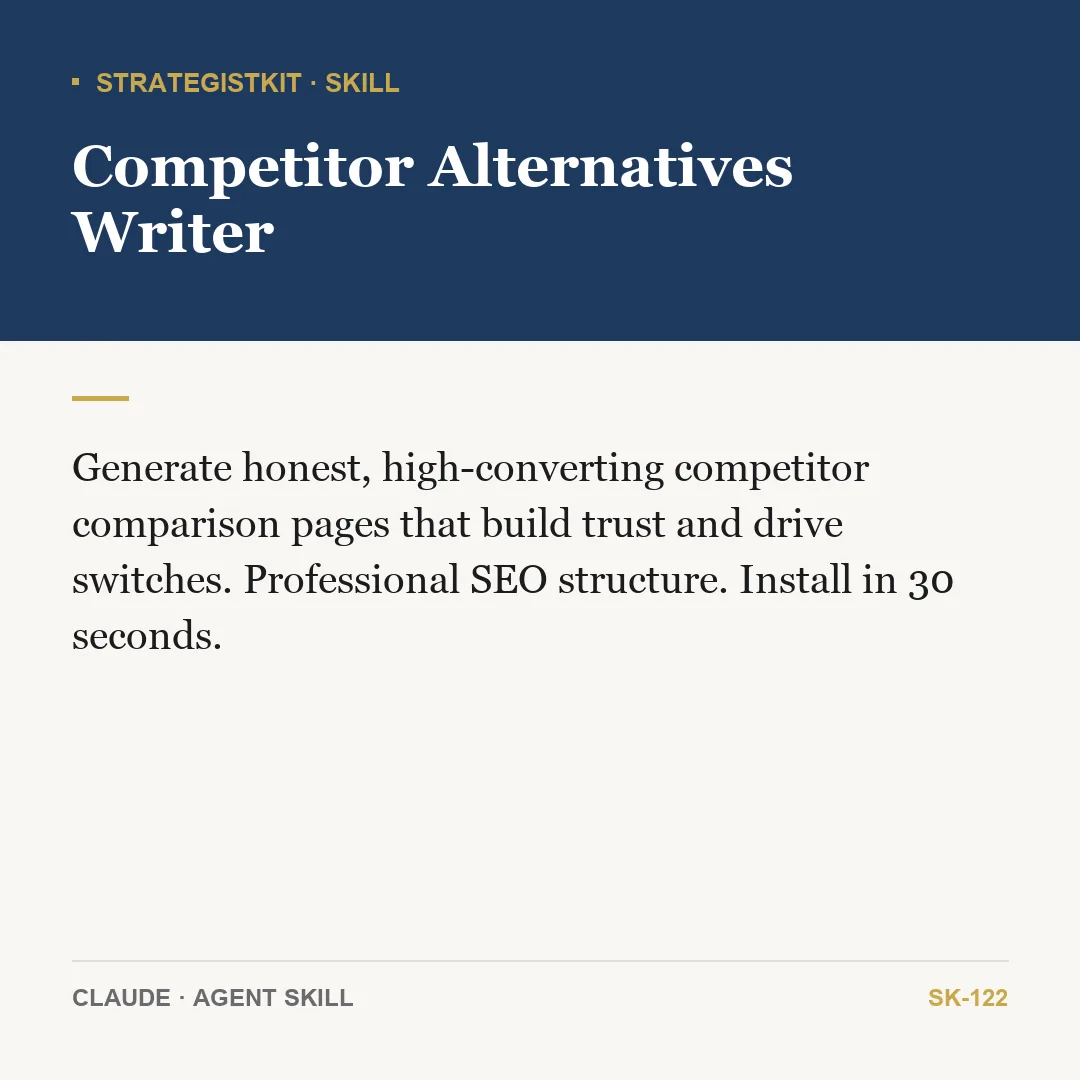
Competitor Alternatives Writer is a Claude skill for Business & Consulting. Generate honest, high-converting competitor comparison pages that build trust and drive switches. It costs $5 on Agensi. It runs on any Claude plan, including Free. Part of the StrategistKit catalog of 190+ focused Claude skills.
10 credits — included with a membership (30 credits/mo).
Prefer a one-time purchase, without joining?
Buy once on Agensi (opens in a new tab)StrategistKit Affiliate. One-time purchase on Agensi. Payment, delivery and refunds are handled by the marketplace — see their policy for refund terms.
Overview
This skill writes a full '[Competitor] alternatives' landing page by leading with honesty rather than spin. You supply your product name, the competitor you want to rank against, and the audience you're targeting. The skill maps where the competitor genuinely wins (and says so), identifies the specific buyer profile that belongs with each product, surfaces the objections the searcher already carries into the page, isolates the one differentiator worth leading with, and assembles everything into a professionally structured SEO page — headline, meta-description, comparison table, migration section, FAQ schema, and a CTA calibrated to late-funnel intent.
Example input: 'My product is a project management tool built for agencies billing hourly. The competitor is Asana. Our audience is agency ops managers who've hit Asana's reporting limits and are now googling alternatives.' The skill first identifies where Asana is genuinely stronger (brand recognition, enterprise integrations, onboarding resources) and flags that Asana is the right call for teams that don't bill clients. It then builds the page around the honest case for switching: time-tracking tied directly to invoicing, client-facing reports out of the box, and pricing that doesn't penalise agencies for adding contractors.
The output includes a ready-to-publish page structure: an H1 that earns the click ('Asana alternatives for agencies that bill by the hour'), a comparison table scoped to switcher-relevant dimensions only, a 'Who should stay with Asana' paragraph that functions as a trust signal, a 200-character meta-description, a migration-cost section addressing the real friction of moving data, and a CTA framed for a buyer who has the competitor's pricing page open in the next tab. All sections follow FAQ schema conventions for potential rich-result eligibility.
Who it's for
Growth marketers, content strategists, and founders who need to capture high-intent '[competitor] alternatives' search traffic without publishing the kind of one-sided feature table that makes skeptical buyers close the tab. Particularly useful for SaaS and B2B products competing against a well-known incumbent where trust is the conversion bottleneck.
How it works
Add the .skill file to your Claude app. About 10 seconds.
Invoke the skill and paste in your material.
Review, keep what works, and use it.
In depth
A copy-paste prompt runs one static pass and stops. A skill is a bundled program — instructions, examples, and a workflow Claude runs as a unit: it asks for the right input, applies the same pattern every time, and returns the structured outputs above.
FAQ
At minimum: your product name and what it does, the competitor you want to target, and a description of the buyer you're trying to convert. The more you can say about genuine differences — including where the competitor is stronger — the more credible and targeted the output will be.
It produces the full page package: H1 headline, meta-description, comparison table, body sections, a 'who should stay with the competitor' admission, a migration/switching-cost section, FAQ schema markup, and a closing CTA. You can use the output directly in your CMS or pass it to a developer.
Yes. Each run takes a fresh competitor and audience as input and produces a page built around that specific matchup. The honesty framing, comparison dimensions, and CTA will differ meaningfully between runs because the switcher intent and objections are different for each competitor.
The skill asks about your product, the competitor, and the audience, then does the prioritisation itself. It selects the differentiator most likely to be both true and hard for the competitor to copy, rather than defaulting to whichever feature your marketing team already emphasises.
That is actually the primary use case. The honest-framing approach is most effective precisely when the incumbent has brand authority and the searcher is skeptical of vendor bias. Acknowledging where the larger competitor wins is what makes the rest of the page credible.
More in Business & Consulting
Part of these collections
We use cookies for anonymous analytics (read more). Accept, decline, or choose for yourself.