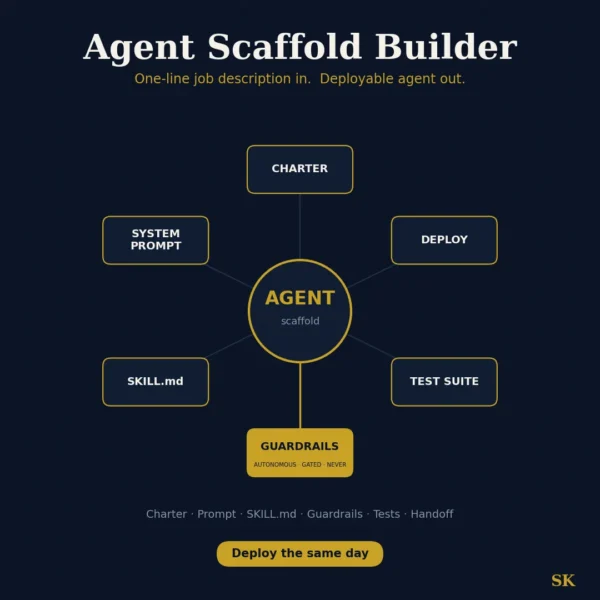
Agent Scaffold Builder
$8.99View skill
Skill · AI & Development
Codebase Architecture Improver is a Claude skill for AI & Development. Systematically fix circular dependencies and technical debt with a prioritized refactoring roadmap. It costs $12.99 on Agensi. It runs on any Claude plan, including Free. Part of the StrategistKit catalog of 190+ focused Claude skills.
10 credits — included with a membership (30 credits/mo).
Prefer a one-time purchase, without joining?
Buy once on Agensi (opens in a new tab)StrategistKit Affiliate. One-time purchase on Agensi. Payment, delivery and refunds are handled by the marketplace — see their policy for refund terms.
Overview
The Codebase Architecture Improver runs a structured diagnostic against your repository's dependency graph, not a surface-level style audit. It maps actual import and call directions, flags circular dependencies, layering violations, and god objects, then sequences a series of bounded micro-refactors that keep the codebase deployable at every step. The sequencing is deliberate: changes with the lowest blast radius and highest leverage come first, so no refactor blocks the next.
A typical input is a developer pasting a directory tree or a set of module files from a TypeScript monorepo that has grown beyond its original structure, noting symptoms like 'tests take forever because half the app bootstraps for a single unit test' or 'adding a feature in the payments module keeps breaking the user module.' The skill maps what is causing those symptoms at the architectural level and produces a prioritized action list.
The output excerpt below illustrates the structure returned: Dependency Violation (Critical): `billing` imports directly from `auth/internal/session`. Boundary broken: auth internals exposed to billing layer. Recommended seam: Introduce AuthSessionPort interface in `auth/ports`; route billing through the port. Sequence position: Step 1 — no downstream module depends on this change. Remaining violations follow in priority order, each tagged with estimated change-cost and the modules at risk if deferred.
Who it's for
Backend and full-stack engineers inheriting a legacy codebase, as well as technical leads scaling a startup MVP toward a maintainable production system, who need a concrete remediation plan rather than generic advice to 'decouple your modules.'
How it works
Add the .skill file to your Claude app. About 10 seconds.
Invoke the skill and paste in your material.
Review, keep what works, and use it.
In depth
A copy-paste prompt runs one static pass and stops. A skill is a bundled program — instructions, examples, and a workflow Claude runs as a unit: it asks for the right input, applies the same pattern every time, and returns the structured outputs above.
FAQ
At minimum, paste in a directory structure and representative module files showing import relationships. The more you can share about symptoms—slow test suites, frequent cross-module breakages, onboarding friction—the more targeted the prioritized roadmap will be.
The diagnostic methodology is language-agnostic. It works best with TypeScript, JavaScript, Python, Go, and Java codebases that use explicit module or package systems, since those make dependency directions traceable. Framework-specific layering conventions (e.g., Clean Architecture in NestJS, Django app boundaries) are factored in when you describe your stack.
You receive a dependency violation list ranked by severity and blast radius, a plain-language description of each structural root cause, and a sequenced list of micro-refactors with guidance on where to introduce interfaces or seams. It is designed to be handed directly to a developer or inserted into a technical design document.
The primary output is a structured architectural audit and refactoring roadmap. It can accompany that roadmap with example interface definitions or module boundary sketches, but it is not a code-generation tool—it tells you exactly what to change, in what order, and why, so your team executes with full understanding.
Yes, particularly if you are a technical lead preparing a growing MVP for a first major scaling event. Catching layering violations and tight coupling at 20,000 lines is significantly cheaper than at 200,000. The skill adapts its triage to the actual severity it finds rather than assuming the codebase is already in crisis.
More in AI & Development
Part of these collections
We use cookies for anonymous analytics (read more). Accept, decline, or choose for yourself.