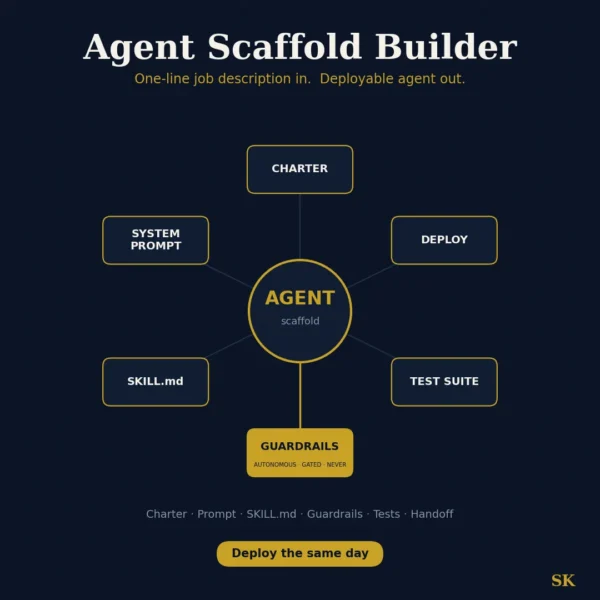
Agent Scaffold Builder
$8.99View skill
Skill · AI & Development
Code Migration Planner is a Claude skill for AI & Development. Design zero-downtime migrations with risk-first sequencing, rollback gates, and Strangler Fig patterns. It costs $9.99 on Agensi. It runs on any Claude plan, including Free. Part of the StrategistKit catalog of 190+ focused Claude skills.
10 credits — included with a membership (30 credits/mo).
Prefer a one-time purchase, without joining?
Buy once on Agensi (opens in a new tab)StrategistKit Affiliate. One-time purchase on Agensi. Payment, delivery and refunds are handled by the marketplace — see their policy for refund terms.
Overview
Code Migration Planner installs as a Claude skill and acts as an architect-level advisor for any codebase transition you describe. It opens by asking four focused questions — your stack, target state, constraints, and audience — then generates a sequenced plan that ships continuously to main. Every phase gets a rollback gate; any step that cannot be reversed is flagged explicitly rather than buried. The skill applies Strangler Fig boundaries, dual-write verification, and feature-flag routing as structural tools, not suggestions.
A typical session starts with input like: 'We have a 200k-line Django 2.2 monolith, four backend engineers, a hard freeze in eight weeks, and we need to extract the billing service first because it blocks a compliance audit.' The skill identifies the riskiest assumption — usually data consistency between the old and new billing paths — designs phase one as the smallest real test of that assumption, and builds the rest of the sequence from there.
The output is a structured migration plan. Example excerpt — Phase 1 Rollback Gate: 'If dual-write divergence exceeds 0.1% over 48 hours in canary traffic, revert feature flag to legacy path. Exit criteria: zero divergence for 72 hours, audit log parity confirmed, no P1 alerts. Estimated effort: 1 engineer, 5 days. Phase 2 prerequisite: Phase 1 gate passed and compliance sign-off received.'
Who it's for
Backend engineers and tech leads planning a major version upgrade, framework swap, or monolith decomposition who need a defensible, incremental plan — not a rewrite ticket. Particularly useful when a migration must stay shippable throughout and involve more than one engineer.
How it works
Add the .skill file to your Claude app. About 10 seconds.
Invoke the skill and paste in your material.
Review, keep what works, and use it.
In depth
A copy-paste prompt runs one static pass and stops. A skill is a bundled program — instructions, examples, and a workflow Claude runs as a unit: it asks for the right input, applies the same pattern every time, and returns the structured outputs above.
FAQ
At minimum: your source and target (e.g. Python 2 to 3, monolith to microservices), approximate codebase size, team size, and any hard constraints like deadlines or compliance requirements. The skill asks these conversationally and accepts 'decide for me' if you want it to proceed with defaults.
It adapts. Strangler Fig, dual-write, and feature-flag routing are applied where they fit your described architecture. If your situation calls for a different boundary strategy, the skill will say so and explain why.
By default, complex migrations produce a structured document with phases, rollback gates, exit criteria, and effort estimates. For quick questions it returns direct bullets. You can request a checklist or copy-paste spec instead.
It works across the scale spectrum — swapping a single ORM, porting a frontend build tool, or decomposing a full monolith. The risk-first sequencing and rollback gates are just as useful for a focused library replacement as for a multi-quarter replatform.
It produces plans, phase definitions, rollback criteria, and verification logic descriptions — not executable code. The output is designed to be handed to engineers as a spec or used to structure sprint planning.
More in AI & Development
Part of these collections
We use cookies for anonymous analytics (read more). Accept, decline, or choose for yourself.