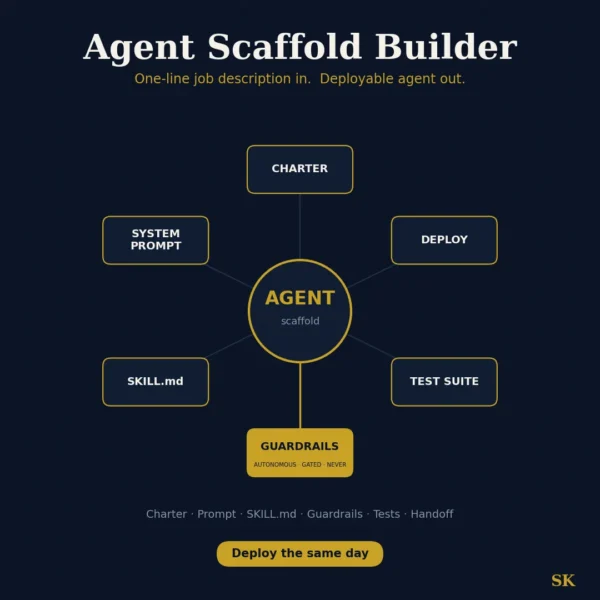
Agent Scaffold Builder
$8.99View skill
Skill · AI & Development
AI Agent Production Hardening Kit is a Claude skill for AI & Development. Harden AI agents for production with safety guardrails, error recovery, and reliability audits. It costs $12.99 on Agensi. It runs on any Claude plan, including Free. Part of the StrategistKit catalog of 190+ focused Claude skills.
10 credits — included with a membership (30 credits/mo).
Prefer a one-time purchase, without joining?
Buy once on Agensi (opens in a new tab)StrategistKit Affiliate. One-time purchase on Agensi. Payment, delivery and refunds are handled by the marketplace — see their policy for refund terms.
Overview
This skill works through ten production risk surfaces in a single session: prompt injection vectors, jailbreak exposure, tool-call blast radius, hallucination failure modes, retry and circuit-breaker logic, rate limiting, cost controls, observability hooks, graceful degradation, and regression test design. You describe your agent architecture and deployment environment; it calibrates every section to your stack and constraints, then returns a threat model, a guardrail specification, and a production readiness scorecard built around your specific setup.
A realistic starting point: a developer tells the skill they are launching a customer-facing support agent on a SaaS platform, with three external tool calls, a small ops team, and a two-week runway before go-live. The skill leads with the highest-risk gaps first rather than walking a generic checklist.
Sample output excerpt — Production Readiness Scorecard (partial): Prompt Injection Surface: HIGH RISK — system prompt boundary not enforced before tool dispatch. Recommended control: input sanitization layer + instruction hierarchy audit before any tool call is authorized. Error Recovery: MEDIUM RISK — no circuit-breaker on third-party API timeout. Recommended control: exponential backoff with fallback response after 2 failed retries, log trace ID for ops review. Overall Gate: NOT READY — 3 critical items must close before production.
Who it's for
ML engineers and product developers who have a working agent prototype and need a structured, architecture-specific audit before exposing it to real users or autonomous pipelines. Particularly useful for solo builders and small teams who lack a dedicated LLMOps function to catch production failure modes.
How it works
Add the .skill file to your Claude app. About 10 seconds.
Invoke the skill and paste in your material.
Review, keep what works, and use it.
In depth
A copy-paste prompt runs one static pass and stops. A skill is a bundled program — instructions, examples, and a workflow Claude runs as a unit: it asks for the right input, applies the same pattern every time, and returns the structured outputs above.
FAQ
Describe your agent type (customer-facing, autonomous pipeline, internal tool), the tools or APIs it calls, your deployment environment, team size, and any known constraints like timeline or budget. The more specific you are, the more targeted the threat model and scorecard will be.
The skill adapts to your workflow. Ask for a structured audit report with findings and recommendations, a copy-paste guardrail specification, a prioritized checklist with owner and timeline fields, or direct answers to specific questions. You can request a format or let it default based on what you describe.
Yes. It scales its depth to what you describe. A single-tool customer support bot gets a focused, high-priority gap list. A multi-agent autonomous pipeline gets a fuller threat model covering inter-agent trust boundaries, tool-call propagation risk, and cascading failure modes.
Both are possible. It produces specification-level guardrail designs and scorecard criteria by default, but you can ask it to go deeper on implementation patterns for retry logic, observability hooks, or input sanitization, and it will produce concrete, context-specific guidance rather than generic pseudocode.
The scorecard is structured for that purpose — it lists risk areas, severity ratings, recommended controls, and a readiness gate. You would want to review and edit it before presenting externally, but it is designed to be something you can ship against rather than a rough internal note.
More in AI & Development
Part of these collections
We use cookies for anonymous analytics (read more). Accept, decline, or choose for yourself.