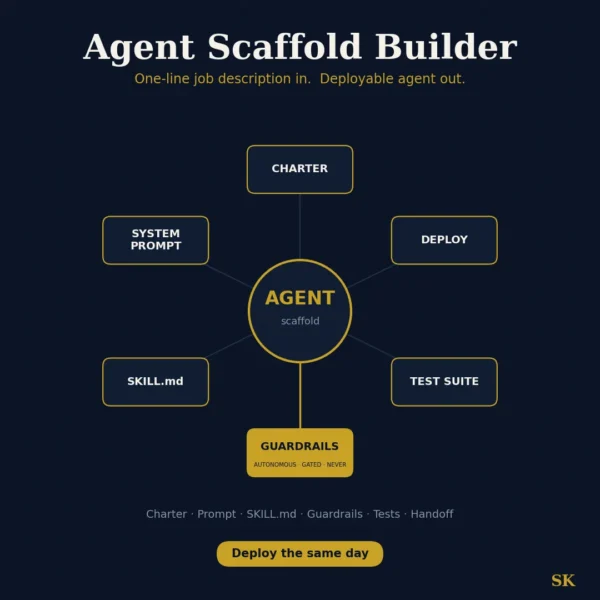
Agent Scaffold Builder
$8.99View skill
Skill · AI & Development
AI Automation QA & UAT Pack is a Claude skill for AI & Development. Builds a complete QA and user-acceptance-testing pack for an AI automation or workflow you describe. It costs $5 on Agensi. It runs on any paid Claude plan. Part of the StrategistKit catalog of 190+ focused Claude skills.
10 credits — included with a membership (30 credits/mo).
Prefer a one-time purchase, without joining?
Buy once on Agensi (opens in a new tab)StrategistKit Affiliate. One-time purchase on Agensi. Payment, delivery and refunds are handled by the marketplace — see their policy for refund terms.
Overview
Describe any AI automation, agent, or workflow you are about to ship or accept — trigger, happy path, external dependencies, who signs off — and this skill generates a complete QA and UAT pack structured around the specific failure modes that unattended, non-deterministic systems actually hit: silent partial failures, prompt drift, idempotency breaks, and invisible errors. It operates in two modes: BUILD (generate from a description) or AUDIT (score an existing workflow's test coverage and surface the gaps). Every artifact it returns has an observable pass/fail condition — nothing vague.
A buyer building an n8n order-to-invoice automation might input: 'Webhook fires on new Shopify order, GPT-4o extracts line items and maps to billing codes, creates an invoice row in Xero, emails the customer a PDF. Peak volume 200/hour. Silent failure means a customer is never invoiced.' The skill produces acceptance criteria in Given/When/Then form, a numbered UAT script the client can run unassisted, a non-determinism test plan for the GPT-4o step, and a failure-mode matrix covering duplicate webhooks, Xero downtime, malformed payloads, and rate-limit bursts.
Sample output excerpt — Failure-Mode Matrix rows: F1 Xero API timeout | Block Xero in test env | Bounded retry x3 then alert, no silent drop | High. F2 Duplicate webhook | Replay identical order ID | Exactly one invoice created, log shows duplicate_skipped | High. F3 GPT-4o returns empty extraction | Send item-less payload | Structured rejection, no partial Xero write | High. Delivered alongside: MUST/SHOULD acceptance criteria, a regression checklist, an observability check, and a client-ready sign-off sheet.
Who it's for
Automation developers, no-code builders, and freelance AI consultants who need to hand off or accept an agent, bot, or workflow pipeline and want a defensible, structured testing record — not a blank checklist they have to invent themselves. Also useful for buyers commissioning AI automations who need to run acceptance testing without a dedicated QA team.
What you get
One .skill bundle. Run it on your material and it returns:
How it works
Add the .skill file to your Claude app. About 10 seconds.
Invoke the skill and paste in your material.
Review, keep what works, and use it.
In depth
A copy-paste prompt runs one static pass and stops. A skill is a bundled program — instructions, examples, and a workflow Claude runs as a unit: it asks for the right input, applies the same pattern every time, and returns the structured outputs above.
FAQ
A plain-English description of the automation: what triggers it, what it does step by step, which external services or APIs it touches, and what a failed run would cost. The more specific you are about non-deterministic steps (LLM calls, classifiers, agent decisions), the more targeted the output.
All output is structured text — tables, numbered scripts, and templated criteria — formatted to paste directly into Notion, Confluence, Linear, a Word doc, or any project tracker. There are no proprietary file exports; you copy what you need.
Yes. The skill is designed for any workflow that runs unattended and calls external services — whether built in n8n, Make, Zapier, a custom Python script, or a multi-agent framework. The automation under test is whatever you describe at runtime.
If you already have a workflow deployed or a partial test suite, AUDIT mode reviews your existing coverage, scores gaps by risk and fix effort, and returns a findings table with a single verdict: READY, READY WITH RISKS, or NOT READY. Use it before a go-live review or after a production incident.
It specifically addresses non-deterministic steps with a dedicated test plan: a golden-set evaluation rubric, a stability check for output variance across repeated runs, adversarial prompt-injection inputs, and defined behaviour for empty or out-of-scope inputs. This is intentionally distinct from standard deterministic pass/fail testing.
More in AI & Development
Part of these collections
We use cookies for anonymous analytics (read more). Accept, decline, or choose for yourself.