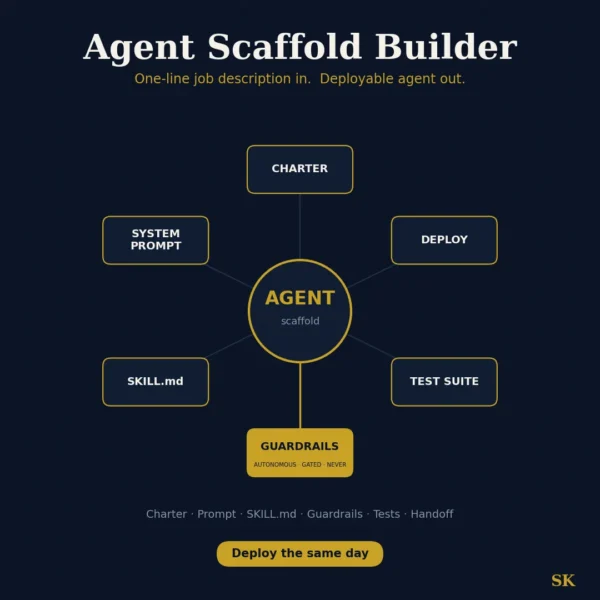
Agent Scaffold Builder
$8.99View skill
Skill · AI & Development
Technical Spec Writer is a Claude skill for AI & Development. Generate rigorous technical specifications that focus on failure modes, data models, and edge cases to catch flaws early. It costs $8.99 on PromptBase. It runs on any Claude plan, including Free. Part of the StrategistKit catalog of 190+ focused Claude skills.
10 credits — included with a membership (30 credits/mo).
Prefer a one-time purchase, without joining?
Buy once on PromptBase (opens in a new tab) Also on Agensi — $9.99 (opens in a new tab)StrategistKit Affiliate. One-time purchase on PromptBase. Payment, delivery and refunds are handled by the marketplace — see their policy for refund terms. PromptBase purchases earn us a referral fee.
Overview
Technical Spec Writer asks four focused questions about your stack, requirements, team, and audience, then produces a spec structured around the sections reviewers actually use to find problems: data model with rationale, state machines for multi-state flows, an explicit failure modes table, security surface, performance assumptions, rollout and rollback plan, and a clean separation of open questions from settled decisions. Rejected alternatives are documented with their real losing reasons, not vague dismissals, which cuts re-litigation in review meetings.
Give it something like: 'We're adding a per-user rate limiter to a Node/Postgres API that currently has no rate limiting. Traffic is 2k req/s at peak, multi-region. Need to ship in two sprints. Audience is two senior engineers and a security lead doing design review.' That context is enough for the skill to calibrate depth, surface the right failure modes, and flag the distributed-counter consistency question before your reviewers do.
The output excerpt below shows the kind of section that separates a reviewable spec from an approvable one: Failure Modes: – Redis unavailable: fail open with degraded limiting (log + alert); document SLA impact – Counter drift under split-brain: bounded over-admission for up to TTL window; acceptable vs. strict quota use cases differ — OPEN – Migration: existing sessions have no counter row; treat as zero-count on first request, not as bypass Open Questions vs. Decisions: – DECIDED: token-bucket over sliding window (simpler rollback path) – OPEN: whether per-user limits apply to internal service tokens — needs product input before implementation
Who it's for
Engineers and tech leads who need a design doc their reviewers can actually attack, not a narrative that describes the happy path and defers the hard questions to implementation. Particularly useful when the system touches shared state, multi-step migrations, or security-sensitive surfaces where an undocumented assumption becomes a production incident.
How it works
Add the .skill file to your Claude app. About 10 seconds.
Invoke the skill and paste in your material.
Review, keep what works, and use it.
In depth
A copy-paste prompt runs one static pass and stops. A skill is a bundled program — instructions, examples, and a workflow Claude runs as a unit: it asks for the right input, applies the same pattern every time, and returns the structured outputs above.
FAQ
At minimum: what the feature does, the relevant parts of your existing stack, who will review the spec, and any hard constraints on timeline or approach. The skill will ask if anything is missing before drafting.
It follows a structure oriented around design review — problem restatement, proposed design, data model, API changes, failure modes, rollout/rollback, alternatives considered, security and performance, and open questions. If your team uses a named template, describe it in context and the skill will adapt.
It documents rejected options with the specific reason each lost — performance trade-off, complexity cost, operational burden — not just 'we chose X'. This section is written to prevent reviewers from re-proposing alternatives that were already evaluated.
Yes. Provide the relevant cross-service context — contracts, ownership boundaries, shared data stores — and the spec will surface the integration failure modes and the questions that need cross-team answers before implementation starts.
That is the intended starting point. The skill will restate the problem and requirements first so you can confirm the framing, then propose a design. If key information is missing, it flags assumptions explicitly so you can correct them before the spec circulates.
More in AI & Development
Part of these collections
We use cookies for anonymous analytics (read more). Accept, decline, or choose for yourself.