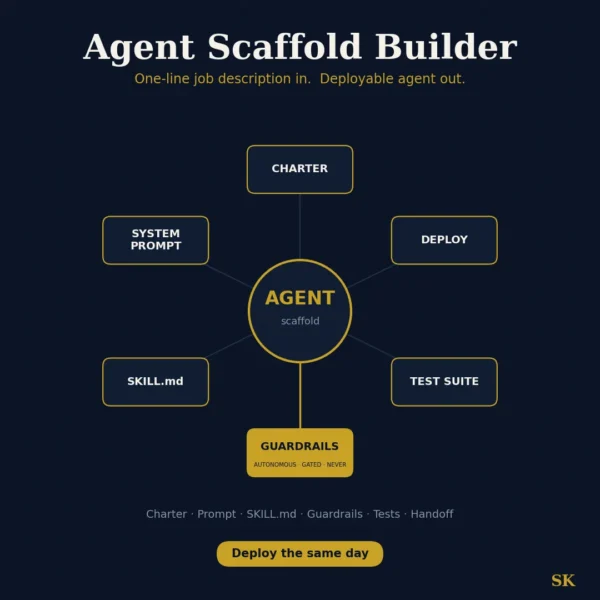
Agent Scaffold Builder
$8.99View skill
Skill · AI & Development
Socratic Code Reviewer is a Claude skill for AI & Development. Get senior-level code reviews that use Socratic questioning to identify architectural flaws and teach better patterns. It's free on Agensi. It runs on any Claude plan, including Free. Part of the StrategistKit catalog of 190+ focused Claude skills.
10 credits — included with a membership (30 credits/mo).
Prefer a one-time purchase, without joining?
Get it free on Agensi (opens in a new tab)StrategistKit Affiliate. One-time purchase on Agensi. Payment, delivery and refunds are handled by the marketplace — see their policy for refund terms.
Overview
Socratic Code Reviewer analyzes code or diffs by first reconstructing the intent of the change, then working through correctness, design, and readability in strict priority order. Each finding opens with the probing question a senior engineer would ask — exposing the underlying flaw rather than just labeling it — followed by a precise explanation and a concrete corrected example. Style notes never surface before correctness or architectural issues.
To use it, paste your code or diff and describe what the change is meant to accomplish. Optionally tell it your stack, team size, and whether you want a quick critique or a formal audit report. From there it runs through intent, correctness, failure paths, concurrency and state ownership, API boundaries, naming, and test adequacy — calibrating depth to your context.
Example output excerpt for a concurrent cache implementation: [CRITICAL] 'What happens to callers that read from this cache between the moment you evict the old entry and the moment the new value is written?' — The current approach creates a read window where stale-or-empty data escapes. Fix: hold the write lock across both the delete and the insert, or use a swap-on-write pattern. See attached corrected snippet. [DESIGN] 'Who owns the eviction policy decision — the cache or its caller?' …
Who it's for
Solo developers and small engineering teams who want rigorous pull-request feedback without a dedicated senior reviewer on call — particularly developers building on unfamiliar patterns (async pipelines, distributed state, layered APIs) who need to understand the reasoning behind changes, not just a list of fixes.
How it works
Add the .skill file to your Claude app. About 10 seconds.
Invoke the skill and paste in your material.
Review, keep what works, and use it.
In depth
A copy-paste prompt runs one static pass and stops. A skill is a bundled program — instructions, examples, and a workflow Claude runs as a unit: it asks for the right input, applies the same pattern every time, and returns the structured outputs above.
FAQ
Paste the code, diff, or implementation sketch you want reviewed, plus a one-sentence description of what the change is supposed to do. The more you describe your stack and constraints, the more precisely the review is calibrated to your situation.
Both. Each finding leads with a Socratic question to surface the flaw, then provides a direct explanation and a concrete code example showing the fix. The questions are a teaching device, not a substitute for actionable guidance.
Yes — the skill reads intent and structure rather than relying on language-specific linting rules, so it works across languages and frameworks. Tell it your stack during the context step and it will tailor examples accordingly.
By default it returns a severity-ranked structured report with sections for correctness, design, failure paths, and test adequacy. If you need a quick bullet summary or a formal audit document, specify that at the start and it adapts.
Yes — those tools catch syntax and style violations. This skill targets the layer they miss: state ownership, boundary design, concurrency hazards, and test gaps that require understanding what the code is intended to do and how it will evolve.
More in AI & Development
Part of these collections
We use cookies for anonymous analytics (read more). Accept, decline, or choose for yourself.