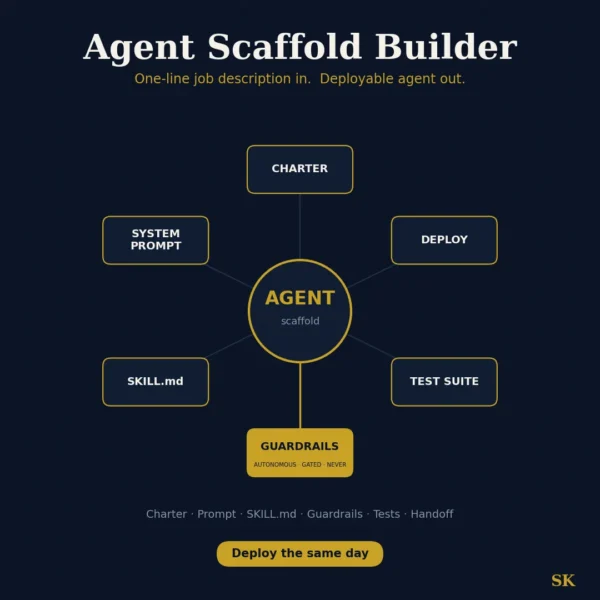
Agent Scaffold Builder
$8.99View skill
Skill · AI & Development
Prompt Engineering Specialist is a Claude skill for AI & Development. Optimize production prompts with structured engineering: reduce contradictions, improve formatting, and build regression tests. It costs $9.99 on Agensi. It runs on any Claude plan, including Free. Part of the StrategistKit catalog of 190+ focused Claude skills.
10 credits — included with a membership (30 credits/mo).
Prefer a one-time purchase, without joining?
Buy once on Agensi (opens in a new tab)StrategistKit Affiliate. One-time purchase on Agensi. Payment, delivery and refunds are handled by the marketplace — see their policy for refund terms.
Overview
This skill treats your prompt as an engineered artifact, not a growing text file. You give it your current prompt, the model you're running it on, and the failure cases that sent you here. It diagnoses which component is breaking — instructions that contradict each other, few-shot examples that avoid the hard edge cases, output specs the parser can't rely on, or context buried where the model won't weight it — then rewrites structurally and documents every decision so the next maintainer understands why the prompt was built that way. It also ships a regression case set so future edits produce measurable results instead of confident guesses.
A typical input: a 1,400-word customer-support system prompt that has accumulated eighteen months of appended fixes, three conflicting tone rules, and a JSON output section the model follows about 70% of the time. You paste it in, list the three failure patterns you see most often, and describe what a good output looks like. The skill asks four scoping questions — your stack, target model, who reads the output, any hard constraints — then begins with failure collection before touching a word of the prompt.
The output you get back includes: a restructured system prompt with role definition, constraint block, and output contract in explicit sections; a plain-English annotation explaining each structural change and why the original caused the failure; a few-shot example set chosen to demonstrate the boundary cases you flagged; and a regression case table with inputs, expected outputs, and the failure mode each case guards against. Everything is formatted for immediate use and future editing without re-discovering the reasoning.
Who it's for
Developers and product teams running Claude or other LLMs in production who have a prompt that worked in testing but behaves inconsistently at scale, or who are building a new prompt and want a structured approach before the accretion problem starts. Particularly useful for anyone who has ever fixed a failure by appending a rule and created two new failures in the process.
How it works
Add the .skill file to your Claude app. About 10 seconds.
Invoke the skill and paste in your material.
Review, keep what works, and use it.
In depth
A copy-paste prompt runs one static pass and stops. A skill is a bundled program — instructions, examples, and a workflow Claude runs as a unit: it asks for the right input, applies the same pattern every time, and returns the structured outputs above.
FAQ
At minimum: your current prompt text, the model it runs on, and one or more concrete failure examples — actual inputs that produced wrong or inconsistent outputs. The more specific the failure cases, the more precise the diagnosis. If you're building a new prompt, share your target output format and the edge cases you're worried about.
The structural principles — instruction ordering, contradiction removal, few-shot selection, output contract specification — apply across major instruction-tuned models. The skill will note any behavior differences relevant to your stated model, but it is not calibrated to model-specific quirks beyond Claude and the mainstream OpenAI models.
A copy-paste-ready system prompt with clearly labeled sections, an annotation block explaining each structural decision, a revised few-shot example set, and a regression case table. For quick audits on short prompts, it defaults to a bullet-format findings list with the rewrite inline.
Yes — component-level diagnosis is one of the first things it does. If the model genuinely cannot perform the task reliably regardless of prompt structure, it will say so explicitly rather than producing an over-engineered prompt that still fails.
That is an explicit goal. Every structural decision is annotated in plain English so you understand the reasoning, not just the result. The regression case set also gives you a method for evaluating future changes without guessing.
More in AI & Development
Part of these collections
We use cookies for anonymous analytics (read more). Accept, decline, or choose for yourself.