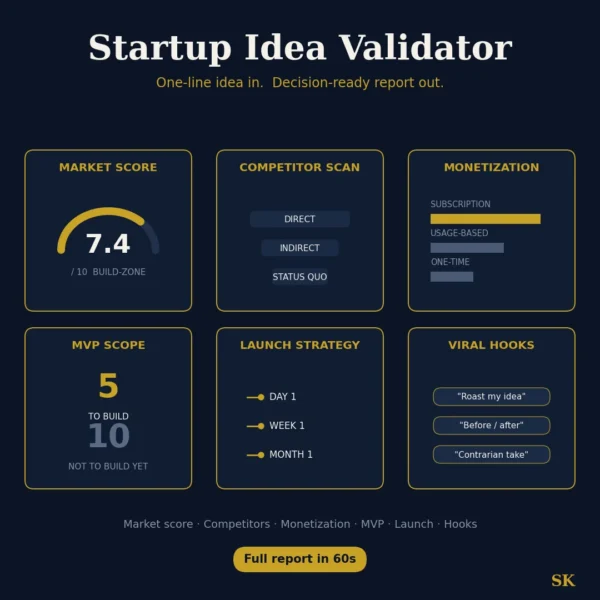
Startup Idea Validator
$8.99View skill
Skill · Business & Consulting
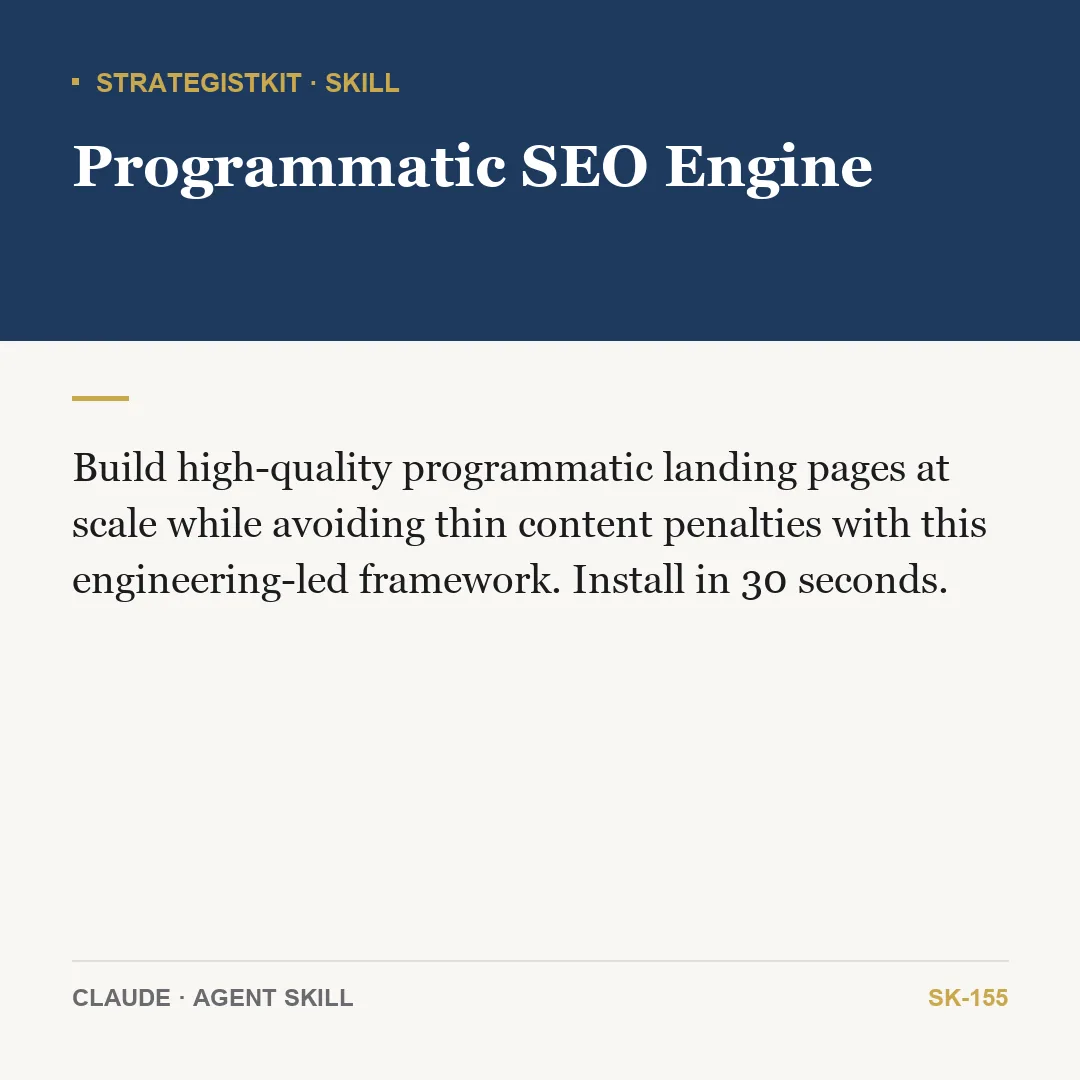
Programmatic SEO Engine is a Claude skill for Business & Consulting. Build high-quality programmatic landing pages at scale while avoiding thin content penalties with this engineering-led framework. It costs $9.99 on Agensi. It runs on any Claude plan, including Free. Part of the StrategistKit catalog of 190+ focused Claude skills.
10 credits — included with a membership (30 credits/mo).
Prefer a one-time purchase, without joining?
Buy once on Agensi (opens in a new tab)StrategistKit Affiliate. One-time purchase on Agensi. Payment, delivery and refunds are handled by the marketplace — see their policy for refund terms.
Overview
The Programmatic SEO Engine runs a structured, multi-stage workflow that starts before any template is written. It first validates whether your keyword pattern has genuine long-tail demand and whether your dataset can deliver something a generic page cannot. From there it guides database schema design, template architecture, dynamic section logic, internal linking maps, crawl budget rules, and indexation monitoring — treating page generation as an engineering problem, not a copy-paste exercise.
A buyer might arrive with this input: 'I want to build comparison pages for 3,000 software tool pairs in the project-management space. My dataset has pricing, feature flags, and G2 ratings. My stack is Next.js with a Postgres backend. I need a template blueprint and a quality-gating rule before I hit publish.' The skill responds by scoping the demand pattern, auditing the dataset for per-page uniqueness signals, and producing a structured spec the developer can act on immediately.
A sample output excerpt for that scenario would include: a dataset schema with required fields and a uniqueness-score formula; a page template blueprint listing fixed vs. dynamic sections (e.g., feature delta table driven by flag diff, not synonym rewriting); a quality threshold rule (e.g., suppress pages where feature overlap exceeds 90% or data fields fall below a minimum count); and an internal linking map connecting tier-1 category hubs to comparison leaf pages.
Who it's for
Developers and growth marketers building location, comparison, or entity-based landing pages at scale — particularly those who have already been burned by thin-content penalties or whose previous pSEO output was deindexed. Also useful for SEO leads auditing an existing programmatic architecture before a site migration or content expansion.
How it works
Add the .skill file to your Claude app. About 10 seconds.
Invoke the skill and paste in your material.
Review, keep what works, and use it.
In depth
A copy-paste prompt runs one static pass and stops. A skill is a bundled program — instructions, examples, and a workflow Claude runs as a unit: it asks for the right input, applies the same pattern every time, and returns the structured outputs above.
FAQ
It asks four things conversationally: your current stack and site context, the specific output you need (audit, template spec, schema design, linking map), any technical or timeline constraints, and who will consume the output. If you prefer, you can say 'decide for me' and it will apply defaults.
Depending on your goal, it produces structured documents (audit reports with findings and recommendations), copy-paste-ready specs (database schemas, template blueprints, dynamic section logic), internal linking maps, or action checklists with owner fields. It matches the format to your stated workflow.
The niche and dataset are runtime inputs you supply. The framework applies equally to 'Best [Service] in [City]' directories, 'X vs Y' comparison pages, technical documentation hubs, or any other pattern — as long as your dataset can justify unique page-level value.
The skill applies a quality-threshold gate before page generation: if a page would not deserve to rank on its own merits — due to insufficient data differentiation, field gaps, or excessive content overlap with sibling pages — the framework flags or suppresses it rather than letting a thin page reach the index.
No. It produces the architectural layer: schema specs, template blueprints, dynamic section definitions, linking logic, and crawl strategy. Actual page rendering stays in your own stack. This keeps the skill useful regardless of whether you are running Next.js, a headless CMS, or a custom static generator.
More in Business & Consulting
Part of these collections
We use cookies for anonymous analytics (read more). Accept, decline, or choose for yourself.