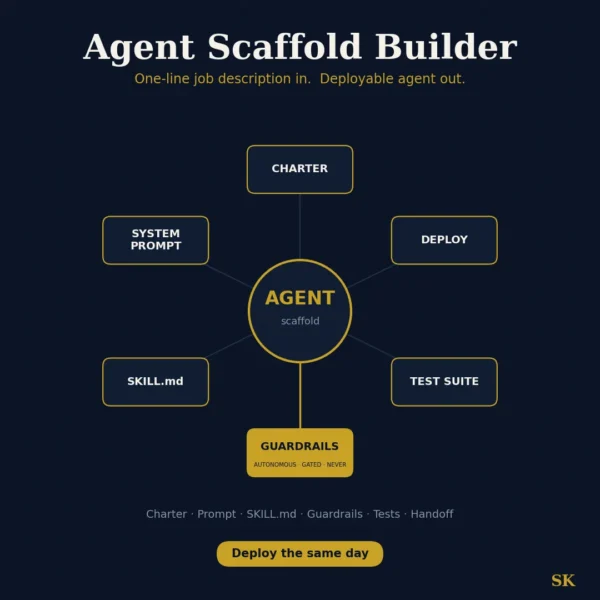
Agent Scaffold Builder
$8.99View skill
Skill · AI & Development
PostgreSQL Schema Architect is a Claude skill for AI & Development. Design high-performance PostgreSQL schemas with optimized indexes, constraints, and multi-tenant logic. It costs $9.99 on Agensi. It runs on any Claude plan, including Free. Part of the StrategistKit catalog of 190+ focused Claude skills.
10 credits — included with a membership (30 credits/mo).
Prefer a one-time purchase, without joining?
Buy once on Agensi (opens in a new tab)StrategistKit Affiliate. One-time purchase on Agensi. Payment, delivery and refunds are handled by the marketplace — see their policy for refund terms.
Overview
PostgreSQL Schema Architect takes your domain model, query patterns, and scale expectations as inputs and returns a complete schema design with every structural decision explained. It works through table layout, normalization versus deliberate denormalization trade-offs, index strategy matched to your specific query shapes, constraint definitions that enforce business rules at the database level rather than in application code, and a migration path if you are evolving an existing schema rather than starting fresh.
A typical input looks like this: a SaaS product serving multiple clients, a domain description covering users, subscriptions, usage events, and billing records, three or four representative slow queries or query patterns you know you need to run fast, and a note that you expect roughly 50 million event rows within a year. The skill uses that context to calibrate every decision — partition strategy, which columns warrant a partial index, where a composite index beats two single-column indexes, and whether a join table or a JSONB column is the right call for your variable-attribute problem.
The output is structured and decision-oriented. Example excerpt: Table: usage_events — Partitioned by range on occurred_at (monthly). Rationale: query filters almost always include a date range; partition pruning eliminates full-table scans at current growth rate. Index: (tenant_id, occurred_at DESC) — covers the tenant-scoped time-series query pattern identified above; a separate index on event_type added only if cardinality analysis supports selectivity. Constraint: tenant_id NOT NULL with FK to tenants enforced at DB level; application-layer checks removed as redundant. Migration note: backfill occurred_at partition key before attaching existing rows to avoid lock escalation.
Who it's for
Backend engineers and technical founders who are designing a new PostgreSQL schema and want trade-off-aware decisions rather than generic advice, and engineers who have hit a performance ceiling on an existing schema and need a structured diagnosis of what to change and in what order.
How it works
Add the .skill file to your Claude app. About 10 seconds.
Invoke the skill and paste in your material.
Review, keep what works, and use it.
In depth
A copy-paste prompt runs one static pass and stops. A skill is a bundled program — instructions, examples, and a workflow Claude runs as a unit: it asks for the right input, applies the same pattern every time, and returns the structured outputs above.
FAQ
At minimum: a description of your domain entities and their relationships, the queries you care most about optimizing, and your rough data volume and growth expectations. The more specific your query patterns, the more precise the index and partitioning recommendations will be.
It returns schema designs with CREATE TABLE structure, index definitions, and constraint logic written in concrete SQL syntax, accompanied by rationale for each decision. You should review and test the output before running it against a production database, as the skill cannot observe your live environment.
Yes. Multi-tenant isolation strategies — row-level tenancy with tenant_id columns and row-level security policies, schema-per-tenant, and database-per-tenant — are within scope. Describe your tenancy model and scale requirements and the skill will recommend the appropriate approach with trade-offs explained.
Yes. Provide your existing DDL and the queries that are slow or expensive, and the skill will identify design problems, propose targeted changes such as index additions or table restructuring, and outline the migration path to get there without unnecessary downtime.
It uses PostgreSQL-specific capabilities where they are the right tool: partial indexes, expression indexes, JSONB column strategies, declarative partitioning, and constraint types like exclusion constraints. Recommendations are scoped to PostgreSQL and will not generalize to other databases.
More in AI & Development
Part of these collections
We use cookies for anonymous analytics (read more). Accept, decline, or choose for yourself.