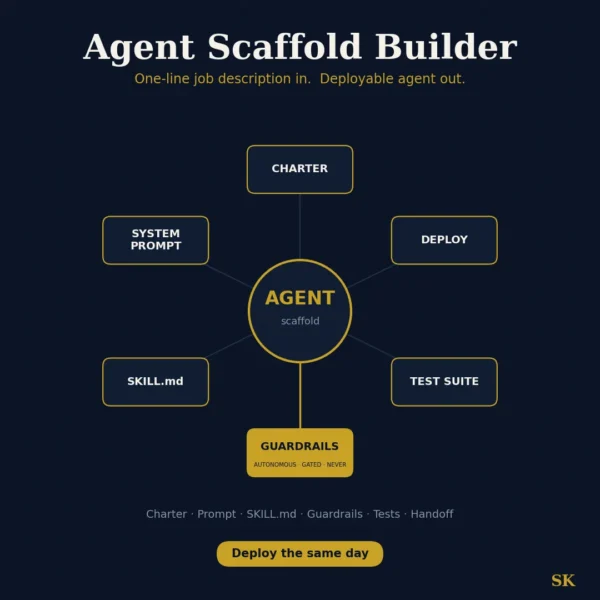
Agent Scaffold Builder
$8.99View skill
Skill · AI & Development
Multi-Agent Orchestration Patterns Library is a Claude skill for AI & Development. Design high-performance multi-agent architectures with proven orchestration patterns, routing logic, and YAML configs. It costs $12.99 on Agensi. It runs on any Claude plan, including Free. Part of the StrategistKit catalog of 190+ focused Claude skills.
10 credits — included with a membership (30 credits/mo).
Prefer a one-time purchase, without joining?
Buy once on Agensi (opens in a new tab)StrategistKit Affiliate. One-time purchase on Agensi. Payment, delivery and refunds are handled by the marketplace — see their policy for refund terms.
Overview
This skill functions as an orchestration architect: you describe your workflow, agent roles, stack, and constraints, and it selects the right topology from a library of proven patterns — sequential pipelines, parallel fan-out/fan-in, hierarchical manager-specialist graphs, map-reduce pipelines, and event-driven dispatcher pools. It then produces a complete system design covering agent role definitions, inter-agent data contracts, routing logic, error escalation paths, model selection guidance per role, and a production hardening checklist.
A buyer working on an automated content pipeline might supply: 'I need agents for web research, drafting, SEO review, and fact-checking. Stack is raw Anthropic API. Must complete in under 90 seconds per run.' The skill identifies a parallel fan-out pattern for the research and SEO steps, a sequential handoff into drafting, and a final critic-actor loop for fact-checking — then outputs role specs, a YAML pipeline config, and the structured handoff contracts each agent must honor.
Returned output includes a labeled architecture diagram in text form, a YAML agent configuration block with model assignments (Opus for orchestrator judgment, Sonnet for workers, Haiku for validators), typed inter-agent handoff schemas in JSON, explicit routing decision rules, failure escalation paths, and a checklist of production-readiness items such as partial-failure handling in the synthesis step and context-limit management across long chains.
Who it's for
Engineers and technical builders who are designing multi-agent systems with Claude, LangGraph, AutoGen, CrewAI, or the raw Anthropic API and want to avoid the architectural missteps — oversized agents, undefined handoffs, wrong topology — that stall projects before reaching production. Also useful for technical leads who need to review or document an existing agent architecture.
How it works
Add the .skill file to your Claude app. About 10 seconds.
Invoke the skill and paste in your material.
Review, keep what works, and use it.
In depth
A copy-paste prompt runs one static pass and stops. A skill is a bundled program — instructions, examples, and a workflow Claude runs as a unit: it asks for the right input, applies the same pattern every time, and returns the structured outputs above.
FAQ
At minimum: what your workflow does, the distinct agent roles you have in mind, and your framework or stack. Latency, cost, or safety constraints are optional but improve the output. If you have no preferences, the skill infers sensible defaults from context.
It produces YAML agent configuration blocks and JSON inter-agent contract schemas that are ready to adapt into your codebase, plus tmux and git-worktree shell snippets for Claude Code parallelization. These are reference artifacts, not a deployable application — you wire them into your stack.
It maps your bottleneck — speed, quality, scale, or autonomy — to the topology that addresses it. Sequential is the default for unknown workflows; parallel fan-out is recommended when tasks are independent; hierarchical when task type is undetermined at runtime; event-driven when agents must react to triggers rather than run on demand.
Yes. The skill covers framework-agnostic patterns and can advise on stack selection based on your constraints before producing the design. It covers Claude Code, LangGraph, AutoGen, CrewAI, and raw API implementations.
Items such as partial-failure handling in fan-in synthesis steps, context-limit management across long chains, model cost allocation by agent role, retry and escalation logic, and merge-review gates for parallel worktree outputs. It is tailored to the pattern selected for your workflow, not a generic list.
More in AI & Development
Part of these collections
We use cookies for anonymous analytics (read more). Accept, decline, or choose for yourself.