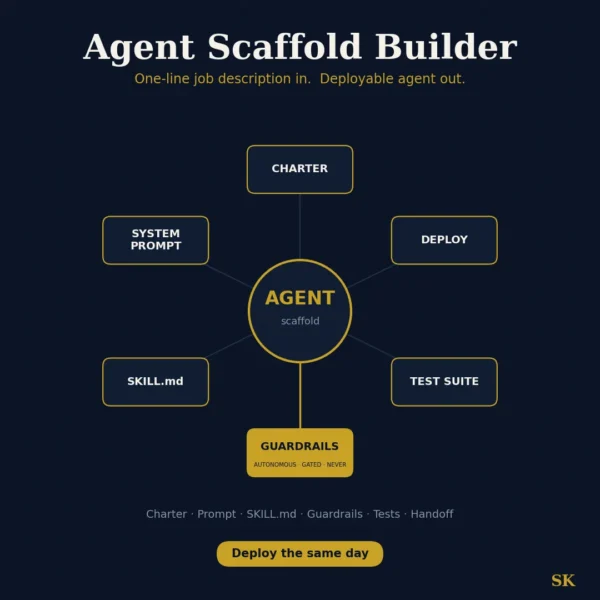
Agent Scaffold Builder
$8.99View skill
Skill · AI & Development
Mobile App UI Designer is a Claude skill for AI & Development. Design native mobile apps with thumb-zone ergonomics and platform-specific patterns for iOS and Android. It costs $9.99 on Agensi. It runs on any Claude plan, including Free. Part of the StrategistKit catalog of 190+ focused Claude skills.
10 credits — included with a membership (30 credits/mo).
Prefer a one-time purchase, without joining?
Buy once on Agensi (opens in a new tab)StrategistKit Affiliate. One-time purchase on Agensi. Payment, delivery and refunds are handled by the marketplace — see their policy for refund terms.
Overview
The skill turns Claude into a mobile product designer who starts from the hand, not the screen. It enforces thumb-zone reachability mapping, separates iOS Human Interface Guidelines from Material Design 3 conventions where they genuinely diverge, and produces platform-specific architectural specs covering navigation structure, gesture affordances, permission-ask timing, and the often-skipped edge states: empty lists, loading skeletons, and offline fallbacks. You supply your platform, app type, and target screens; the skill handles the ergonomic and convention layer.
A typical session: a solo founder building a React Native fitness tracking app asks for help designing a workout logging flow for both iOS and Android. The skill first asks four scoping questions — stack, goal, constraints, and intended audience for the output — then works through thumb-zone mapping for the primary log action, flags where Android should use a bottom sheet while iOS should use a modal card, and drafts the permission choreography for location access before the first workout begins.
Sample output excerpt — Cross-Platform Divergence Call, Workout Start Screen: iOS — primary CTA sits at bottom center (44 pt hit target, safe area inset respected), accessed via modal sheet triggered from tab bar. Android — FAB anchored bottom-right per Material 3 spec; sheet uses predictive back gesture. Both — 'Allow location' permission request deferred until user taps 'Start outdoor run', not on first launch. Component mapping: SwiftUI Sheet vs. Jetpack Compose ModalBottomSheet.
Who it's for
Product designers and developers who are shipping a mobile app and need to avoid the common failure of mixing web patterns with touch interfaces — particularly useful for solo builders, small cross-functional teams, and frontend engineers who own design decisions without a dedicated mobile design lead.
How it works
Add the .skill file to your Claude app. About 10 seconds.
Invoke the skill and paste in your material.
Review, keep what works, and use it.
In depth
A copy-paste prompt runs one static pass and stops. A skill is a bundled program — instructions, examples, and a workflow Claude runs as a unit: it asks for the right input, applies the same pattern every time, and returns the structured outputs above.
FAQ
At minimum: the target platform (iOS, Android, or both), the framework you are building in (SwiftUI, Flutter, React Native, etc.), the app category or core user task, and the specific screens or flows you want to address. The skill will ask four scoping questions before starting; you can also answer them upfront to skip the back-and-forth.
Output adapts to what you need: a structured spec document for developer handoff, a component checklist per platform, a quick annotated screen layout, or a prioritised list of divergence calls between iOS and Android. Specify your preferred format in the scoping step or the skill defaults to the most practical format for your stated goal.
No. The skill produces architectural specs, annotated layout descriptions, component mappings, and decision rationale — text and structured data you carry into Figma, Xcode, or your codebase. It is a design-thinking and specification layer, not a visual renderer.
Yes. The skill explicitly flags the subset of screens and interactions where platform conventions require divergence, so you can share the majority of your component tree while overriding only what native users will notice. It maps those divergence points to React Native or Flutter-specific implementation patterns.
Yes. Frame your goal in the scoping step as an audit rather than a new design, share your current screen descriptions or component list, and the skill will return findings against HIG and Material Design 3 standards with prioritised recommendations rather than starting from scratch.
More in AI & Development
Part of these collections
We use cookies for anonymous analytics (read more). Accept, decline, or choose for yourself.