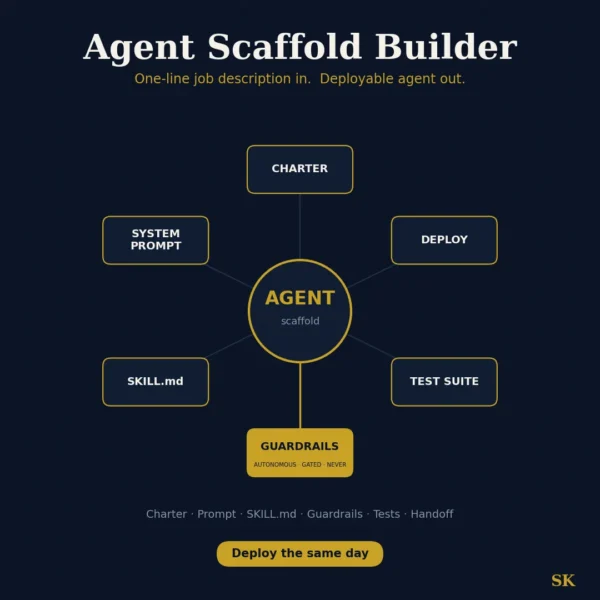
Agent Scaffold Builder
$8.99View skill
Skill · AI & Development
MCP Server Architect is a Claude skill for AI & Development. Design high-performance Model Context Protocol servers. It costs $12.99 on Agensi. It runs on any Claude plan, including Free. Part of the StrategistKit catalog of 190+ focused Claude skills.
10 credits — included with a membership (30 credits/mo).
Prefer a one-time purchase, without joining?
Buy once on Agensi (opens in a new tab)StrategistKit Affiliate. One-time purchase on Agensi. Payment, delivery and refunds are handled by the marketplace — see their policy for refund terms.
Overview
MCP Server Architect starts from agent tasks, not endpoint lists. You describe the system you want to expose and the jobs the agent needs to do; the skill works out which tools to surface, how to compose them at the right abstraction level, what to bundle versus split, how to write names and descriptions the model actually uses to pick correctly, and how to handle auth, errors, state, and pagination in ways that survive production. Every tool description and schema is treated as prompt text, because that is how the model consumes it.
A typical session: you paste your API reference or describe a REST backend — say, a project management platform with endpoints for tasks, comments, users, projects, and webhooks — and explain that your agent should let a user create, update, and query work without ever touching the UI. The skill asks four scoping questions about your stack, team size, constraints, and who will drive the agent, then produces a complete MCP design rather than a mirrored endpoint list.
The output is structured and copy-paste ready. For the above case it might return: a consolidated tool surface (create_task, update_task, query_tasks, get_project_context — not twenty separate CRUD endpoints), annotated tool descriptions written for model disambiguation, a resources-vs-tools split table showing which data belongs in a resource primitive versus a callable tool, an error-message spec with actionable text the model can reason on, and a testing checklist keyed to the actual agent tasks rather than HTTP coverage.
Who it's for
Backend and full-stack developers building MCP servers for Claude-powered agents who have hit the wall of model confusion, wrong-tool selection, or demo-only reliability. Also useful for AI product engineers who need to expose an existing API to an agent without redesigning the API itself.
How it works
Add the .skill file to your Claude app. About 10 seconds.
Invoke the skill and paste in your material.
Review, keep what works, and use it.
In depth
A copy-paste prompt runs one static pass and stops. A skill is a bundled program — instructions, examples, and a workflow Claude runs as a unit: it asks for the right input, applies the same pattern every time, and returns the structured outputs above.
FAQ
At minimum, describe the system you want to expose (endpoints, data model, or a rough API summary) and the agent tasks you want it to support. The skill will ask four clarifying questions about stack, constraints, team, and intended audience before producing the design.
The skill adapts to your workflow. It can return a structured spec document with sections for tool surface, descriptions, resource split, auth patterns, and test checklist; a quick-answer format with direct bullets; or a copy-paste-ready template. For most MCP design sessions it defaults to a structured spec.
Yes. The design principles apply regardless of transport. You describe what your system can do and what the agent needs to accomplish; the skill architects the MCP surface from that, not from the wire format.
No. It produces the architectural design: tool inventory, schemas, descriptions, resource definitions, error patterns, and test cases. Implementation is on you, but the output is detailed enough to hand directly to a developer or feed into a code-generation step.
The skill flags versioning and spec currency as an explicit concern in its output, noting which design decisions are tied to current spec conventions. You should re-run the design if the MCP spec changes materially.
More in AI & Development
We use cookies for anonymous analytics (read more). Accept, decline, or choose for yourself.