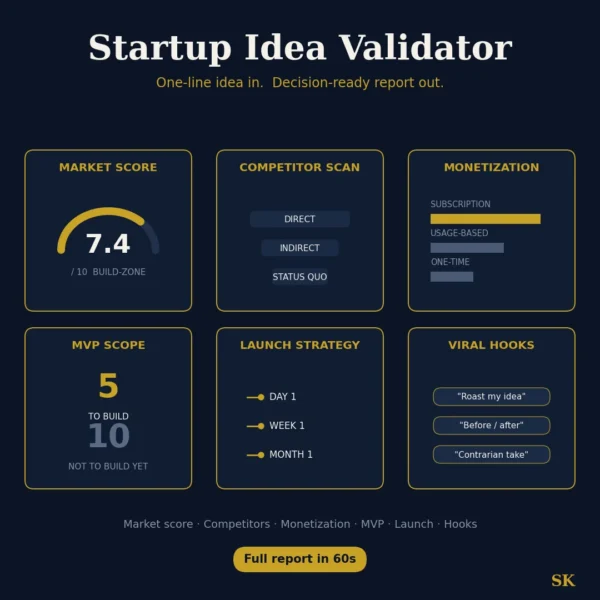
Startup Idea Validator
$8.99View skill
Skill · Business & Consulting
Idea to PRD Generator is a Claude skill for Business & Consulting. Convert product ideas into detailed requirements docs with scope, success metrics, and edge cases. It costs $9.99 on Agensi. It runs on any Claude plan, including Free. Part of the StrategistKit catalog of 190+ focused Claude skills.
10 credits — included with a membership (30 credits/mo).
Prefer a one-time purchase, without joining?
Buy once on Agensi (opens in a new tab)StrategistKit Affiliate. One-time purchase on Agensi. Payment, delivery and refunds are handled by the marketplace — see their policy for refund terms.
Overview
Before writing a single requirement, this skill interrogates the idea: who actually has this problem, how do they cope today, and what would have to be true for them to switch? Once the thinking is done, it produces a structured PRD covering the problem statement and target users, in-scope and out-of-scope boundaries, functional requirements with edge cases, labelled assumptions paired with validation plans, open questions assigned to owners, measurable success criteria, and rollout considerations. The output is designed to surface disagreement early — not after the sprint has started.
To use it, describe your product idea, the user problem you're solving, your tech stack or team constraints, and who will read the document — engineer, designer, executive, or yourself. The skill adapts the depth and framing to that audience. If you're still fuzzy on details, it will ask before assuming.
Example output excerpt — Non-Goals & Scope Boundaries section: 'Out of scope for v1: bulk import from third-party sources, role-based permission levels, and offline mode. These are explicitly deferred — not forgotten — to keep the initial build estimable in a two-week sprint. Any request to add them before launch requires a scope change discussion with the PM and a revised estimate from engineering.' This kind of written boundary is what prevents mid-sprint scope creep.
Who it's for
Product managers, founders, and technical leads who need to move a rough idea into a spec their team can act on without scheduling three alignment meetings first. Especially useful when the person writing the PRD is also the person with the idea — and therefore most likely to skip the parts that feel obvious but aren't.
How it works
Add the .skill file to your Claude app. About 10 seconds.
Invoke the skill and paste in your material.
Review, keep what works, and use it.
In depth
A copy-paste prompt runs one static pass and stops. A skill is a bundled program — instructions, examples, and a workflow Claude runs as a unit: it asks for the right input, applies the same pattern every time, and returns the structured outputs above.
FAQ
Describe the idea, the problem it solves, the users it targets, and any known constraints — tech stack, timeline, team size, legal considerations. The more context you give, the more specific the PRD. If you're missing details, the skill will ask before making assumptions.
Yes. Non-goals get their own section with explicit reasoning for deferral, not just a bullet list of 'not this.' The intent is to make scope disagreements specific and resolvable before build begins.
A structured document with clearly labelled sections — problem statement, users, functional requirements, edge cases, assumptions, open questions, success metrics, and rollout considerations. It is designed to be copy-paste ready for Notion, Confluence, Google Docs, or any plain-text environment.
That is its best use case. It treats every 'we assume' as something to label and validate rather than paper over. Gaps become open questions with suggested owners, not silent risks buried in the prose.
Yes. The skill asks who will read or use the output and adjusts the level of technical detail, the framing of success metrics, and the depth of rollout considerations accordingly.
More in Business & Consulting
Part of these collections
We use cookies for anonymous analytics (read more). Accept, decline, or choose for yourself.