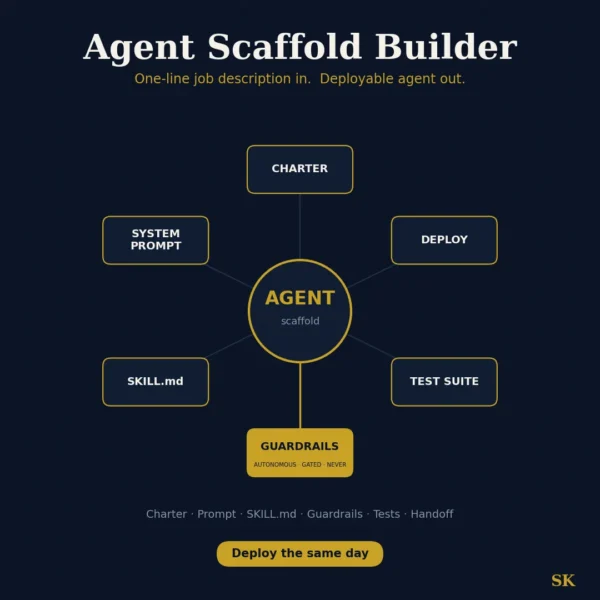
Agent Scaffold Builder
$8.99View skill
Skill · AI & Development
Git Worktree Manager is a Claude skill for AI & Development. Eliminate stash juggling and context switching with optimized Git worktree flows for parallel development. It costs $8.99 on Agensi. It runs on any Claude plan, including Free. Part of the StrategistKit catalog of 190+ focused Claude skills.
10 credits — included with a membership (30 credits/mo).
Prefer a one-time purchase, without joining?
Buy once on Agensi (opens in a new tab)StrategistKit Affiliate. One-time purchase on Agensi. Payment, delivery and refunds are handled by the marketplace — see their policy for refund terms.
Overview
Git Worktree Manager handles the full lifecycle of parallel worktree setups: it asks about your repo structure, current branch situation, and what kind of parallel work you need — hotfix alongside active feature development, a review checkout, or concurrent AI agent sessions — then returns a concrete directory layout, the exact shell commands to create each worktree, and a plan for isolating node_modules, build caches, ports, and env files per worktree. It pairs every setup with a cleanup habit so stale worktrees do not accumulate.
A typical input looks like: a Next.js monorepo on main, a half-finished feature branch, and a production hotfix that just landed in your queue — you need both running locally at the same time without losing your dev server state or build cache. The skill diagnoses that as a hotfix-during-feature pattern, proposes a sibling directory layout, and specifies exactly which config files need symlinking versus copying.
Example output excerpt — Directory Layout: ../repo-feature (worktree, port 3000, own node_modules), ../repo-hotfix (worktree, port 3001, own node_modules). Setup: git worktree add ../repo-hotfix hotfix/payment-crash && cd ../repo-hotfix && npm ci. Env: symlink .env.local from main worktree; .env.production stays isolated. Cleanup trigger: git worktree remove ../repo-hotfix after merge confirmed.
Who it's for
Solo developers and small teams who regularly need to hold two or more branches in a runnable state at once — particularly those doing hotfix response during active feature sprints, running parallel Claude Code agent sessions, or reviewing pull requests without abandoning a work-in-progress dev environment.
How it works
Add the .skill file to your Claude app. About 10 seconds.
Invoke the skill and paste in your material.
Review, keep what works, and use it.
In depth
A copy-paste prompt runs one static pass and stops. A skill is a bundled program — instructions, examples, and a workflow Claude runs as a unit: it asks for the right input, applies the same pattern every time, and returns the structured outputs above.
FAQ
Your stack (language, package manager, build tool), your current branch situation (which branches, what state they are in), and what you need to do in parallel — the skill asks these conversationally and can proceed with smart defaults if you are unsure.
It returns ready-to-run shell commands and directory conventions you execute yourself — it does not push commits, install hooks, or modify your repo autonomously.
Yes. The skill covers port isolation and build-cache separation regardless of package manager; tell it your stack in the context step and it adapts the layout and commands accordingly.
Yes. There is a dedicated stale-worktree audit section that walks through identifying, safely removing, and verifying dangling worktrees without data loss.
It includes a team-conventions output — naming schemas, shared versus isolated config rules, and lifecycle guidelines — formatted as a reference you can drop into a README or internal wiki.
More in AI & Development
Part of these collections
We use cookies for anonymous analytics (read more). Accept, decline, or choose for yourself.