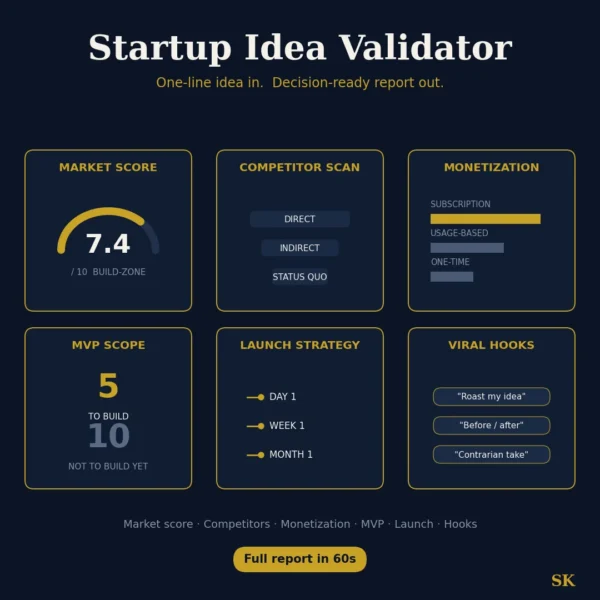
Startup Idea Validator
$8.99View skill
Skill · Business & Consulting
Enterprise Automation Architect is a Claude skill for Business & Consulting. Architect resilient, enterprise-grade automation pipelines and harden fragile scripts with a modular, set-and-forget framework. It costs $29.99 on Agensi. It runs on any Claude plan, including Free. Part of the StrategistKit catalog of 190+ focused Claude skills.
10 credits — included with a membership (30 credits/mo).
Prefer a one-time purchase, without joining?
Buy once on Agensi (opens in a new tab)StrategistKit Affiliate. One-time purchase on Agensi. Payment, delivery and refunds are handled by the marketplace — see their policy for refund terms.
Overview
This skill installs two operating modes into Claude. In DESIGN mode, it takes a loose description of a business automation — trigger, dependencies, failure cost — and produces a modular folder architecture, adapter contracts, a Mermaid flowchart, and a runbook.md ready for DevOps handoff. In HARDEN mode, it audits pasted or linked code against a scored matrix (Impact squared divided by Effort), surfaces silent-failure risks and side-effect bugs, then outputs a prioritized fix plan with every change mapped to a specific robustness gate. Both modes automatically select a robustness tier — T1 Low, T2 Standard, or T3 Critical — and state upfront what is being built and what is deliberately omitted.
A realistic input for HARDEN mode: paste a Python script that polls an order API every five minutes and writes invoices to a billing system, then add 'this occasionally double-posts invoices and I have no idea when it fails.' The skill identifies the absence of idempotency keys as a critical gap, flags unbounded retries as a risk, scores each finding, and returns a concrete fix plan referencing the exact functions to change.
Example output excerpt from HARDEN mode — structured, not prose: Mode: HARDEN | Tier: T3 Critical Finding F-01 | Score 9 | INV-5 violation: no idempotency ledger — double-posts confirmed possible Fix: introduce ledger keyed on order_id+invoice_date before adapters/billing.post_invoice call Finding F-02 | Score 6 | INV-1 violation: no read timeout on CRM poll — unbounded wait on slow response Fix: add connect_timeout=5, read_timeout=20 to adapters/crm.get_orders Acceptance checklist: 12 gates, 2 failing — F-01, F-02 must close before merge.
Who it's for
Backend engineers, DevOps leads, and technical founders who maintain automation pipelines, integration jobs, or scheduled scripts that run unattended in production and have been bitten by silent failures, double-run bugs, or brittle single-file scripts that nobody wants to touch.
How it works
Add the .skill file to your Claude app. About 10 seconds.
Invoke the skill and paste in your material.
Review, keep what works, and use it.
In depth
A copy-paste prompt runs one static pass and stops. A skill is a bundled program — instructions, examples, and a workflow Claude runs as a unit: it asks for the right input, applies the same pattern every time, and returns the structured outputs above.
FAQ
DESIGN mode returns a module map, a Mermaid flowchart, adapter interface contracts, and a runbook.md. HARDEN mode returns a scored finding table, a prioritized fix plan tied to specific code locations, and a 12-point acceptance checklist indicating which gates pass and which are still open.
Paste or describe the existing code and add context about how it is triggered, what external systems it touches, and what failure behavior you have observed. The skill will ask for anything critical that is missing before proceeding.
The architectural patterns — adapters, orchestration layer, shared resilience utilities — are language-neutral. The reference implementation examples in the skill use Python, so Python projects get the most directly runnable output; for other languages the same patterns are applied with equivalent constructs.
It calibrates a robustness tier before designing anything. A low-stakes internal job that fails visibly defaults to T1 and explicitly drops circuit breakers and metrics hooks. A pipeline touching money or customer data lands at T3. The tier and every deliberate omission are stated at the top of the response so you can challenge the decision.
No. It is built for automations that run unattended — scheduled jobs, event-driven pipelines, webhooks, bots, and multi-agent workflows. Using it on a script you run once manually will produce unnecessary scaffolding and overhead that does not match the use case.
More in Business & Consulting
Part of these collections
We use cookies for anonymous analytics (read more). Accept, decline, or choose for yourself.