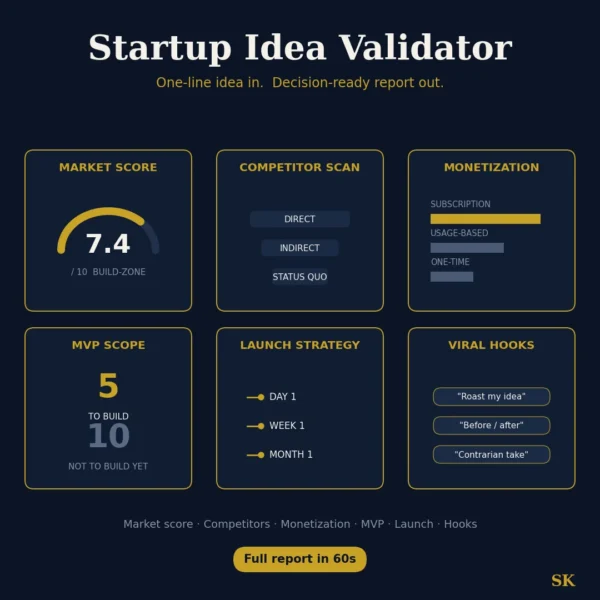
Startup Idea Validator
$8.99View skill
Skill · Business & Consulting
Business Strategy & Decision Intelligence is a Claude skill for Business & Consulting. Generate board-level SWOT analysis, decision memos, and strategic growth plans using consultant frameworks. It costs $5 on Agensi. It runs on any Claude plan, including Free. Part of the StrategistKit catalog of 190+ focused Claude skills.
10 credits — included with a membership (30 credits/mo).
Prefer a one-time purchase, without joining?
Buy once on Agensi (opens in a new tab)StrategistKit Affiliate. One-time purchase on Agensi. Payment, delivery and refunds are handled by the marketplace — see their policy for refund terms.
Overview
This skill applies the analytical discipline of a strategy consultancy to whatever decision or situation you bring it. It opens by separating confirmed facts from working assumptions — the step most internal strategy efforts skip — then structures the situation using SCQA framing before moving into SWOT, competitive positioning, or a full option evaluation matrix. Every output carries explicit assumptions, a weighted decision criteria table, and a clear recommendation with a stated confidence level. You supply your company stage, sector, and the specific question; the skill handles the rigour.
A realistic prompt: a Series B fintech founder inputs that the company is considering a price increase and a simultaneous move upmarket, has 18 months of runway, and needs a board recommendation within two weeks. The skill first surfaces what assumptions are load-bearing — retention elasticity, sales-cycle length for enterprise deals — before building out the analysis.
The output excerpt that follows the situation assessment might look like this: OPTION EVALUATION — Option A (hold price, add enterprise tier): Expected value $1.2M ARR, Investment $340k, Reversibility High, Key risk: sales team ramp. Option B (raise price 20%, current segment): Expected value $0.8M ARR, Investment $40k, Reversibility High, Key risk: 15% churn assumption may be optimistic. Recommendation: Option A, confidence 68%, contingent on hiring one enterprise AE before Q3. Next step: model churn sensitivity at 20% and 25% before board meeting.
Who it's for
Founders, general managers, and in-house strategy leads who need board-ready analysis without retaining an external consultant — particularly for decisions involving market entry, pricing, pivots, or competing strategic options where sloppy framing has real financial cost.
How it works
Add the .skill file to your Claude app. About 10 seconds.
Invoke the skill and paste in your material.
Review, keep what works, and use it.
In depth
A copy-paste prompt runs one static pass and stops. A skill is a bundled program — instructions, examples, and a workflow Claude runs as a unit: it asks for the right input, applies the same pattern every time, and returns the structured outputs above.
FAQ
At minimum: your company's size and stage, the sector you operate in, and the specific decision or question you are working through. It will ask follow-up questions conversationally if key context is missing, or work from sensible defaults if you tell it to proceed.
Outputs are structured prose and tables — situation framing in SCQA format, a SWOT with sized entries and evidence, an option evaluation matrix, and a final decision memo with recommendation and next steps. There is no slide deck; the output is designed to be the source material you or an assistant turns into slides.
It works across stages. You specify your stage at the start and the frameworks adjust — a pre-revenue startup gets scenario stress-testing weighted toward assumptions and runway risk; an established SMB gets more emphasis on competitive response and market-share economics.
It gives a specific recommendation with a stated confidence level and the explicit conditions that would change that recommendation. It is not designed to hedge — it is designed to give you a defensible position you can take into a board or leadership meeting.
The skill is built to reshape the question before applying frameworks. If you describe a situation where a SWOT is not the right tool, it will say so and apply whichever structure — competitive map, scenario matrix, decision criteria weighting — fits the actual problem.
More in Business & Consulting
Part of these collections
We use cookies for anonymous analytics (read more). Accept, decline, or choose for yourself.