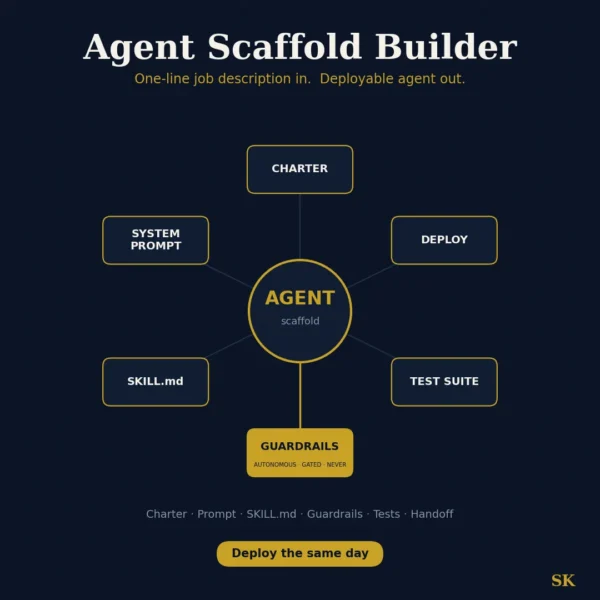
Agent Scaffold Builder
$8.99View skill
Skill · AI & Development
Analytics Tracking Planner is a Claude skill for AI & Development. Build implementation-ready analytics tracking plans and event taxonomies for GA4, Mixpanel, and PostHog. It costs $9.99 on Agensi. It runs on any Claude plan, including Free. Part of the StrategistKit catalog of 190+ focused Claude skills.
10 credits — included with a membership (30 credits/mo).
Prefer a one-time purchase, without joining?
Buy once on Agensi (opens in a new tab)StrategistKit Affiliate. One-time purchase on Agensi. Payment, delivery and refunds are handled by the marketplace — see their policy for refund terms.
Overview
This skill starts from the questions your team needs data to answer, then derives the events and properties required to answer them — not the other way around. You specify your product, the three to five decisions that depend on analytics data, and your stack (GA4, Mixpanel, Amplitude, or PostHog). The skill builds a complete tracking plan: a naming convention locked in before the first event ships, a property table with types and allowed values, anonymous-to-known identity stitching rules, funnel definitions, EU consent constraints, and governance rules that keep the schema clean past the first quarter of growth.
A realistic input looks like: a B2B SaaS checkout flow, questions about where trials drop off and which features correlate with conversion to paid, running on PostHog, team of four with one developer. The skill asks four scoping questions — context, goal, constraints, audience — then produces an implementation-ready plan your developer can build from directly, without a follow-up meeting to interpret it.
Sample output excerpt — Event table (partial): Event: checkout_step_completed | Trigger: user advances past a checkout stage | Properties: step_name (string, enum: plan_select | payment | confirm), plan_id (string), user_id (string), anonymous_id (string) | Owner: backend-eng | Question answered: Where do trials stall before activating a paid plan? | Consent tier: functional (required for product operation, GDPR-exempt with legitimate interest basis)
Who it's for
Product and growth teams who have analytics installed but cannot trust the data because events were added reactively, and developers or analytics engineers who need a spec they can implement without ambiguity rather than a vague list of 'things to track'.
How it works
Add the .skill file to your Claude app. About 10 seconds.
Invoke the skill and paste in your material.
Review, keep what works, and use it.
In depth
A copy-paste prompt runs one static pass and stops. A skill is a bundled program — instructions, examples, and a workflow Claude runs as a unit: it asks for the right input, applies the same pattern every time, and returns the structured outputs above.
FAQ
Output format adapts to what you ask for: a structured document for a full tracking plan, a copy-paste-ready event table for a developer spec, or a checklist with owner fields for a governance audit. You can specify which format you need or let it default to the most practical option for the request.
Yes — the skill tailors naming conventions, identity stitching logic, and implementation notes to the specific platform you name. If you are still deciding between tools, describe that constraint and it will flag the relevant differences that should inform your choice.
Consent constraints are built into the plan, not treated as an afterthought. Each event is assigned a consent tier, and the plan notes which properties may not be collected without explicit opt-in under GDPR, so your legal and engineering teams are working from the same document.
A brief description of the product, the top three to five questions you need data to answer, your analytics stack, and your team size are enough to produce a concrete first plan. The skill flags any assumptions it makes and invites you to correct them before the output is finalised.
Yes. Describe your current event schema and the questions you cannot currently answer, and the skill will diagnose the gaps, flag naming inconsistencies, and produce a remediation plan — including which legacy events to deprecate and how to transition without breaking existing charts.
More in AI & Development
Part of these collections
We use cookies for anonymous analytics (read more). Accept, decline, or choose for yourself.