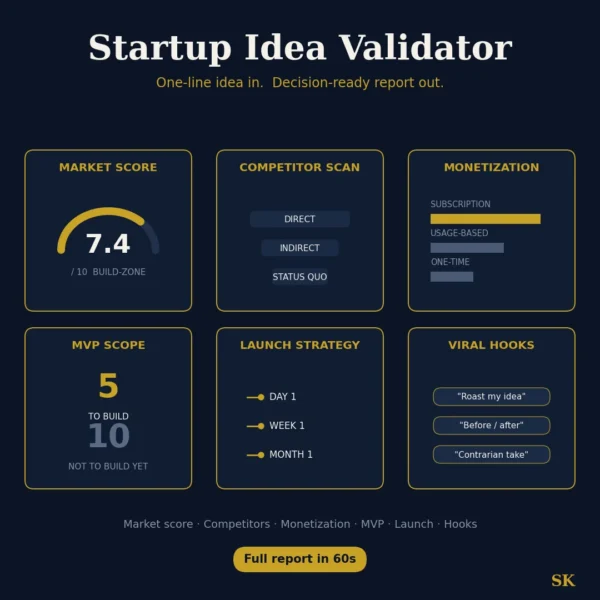
Startup Idea Validator
$8.99View skill
Skill · Business & Consulting
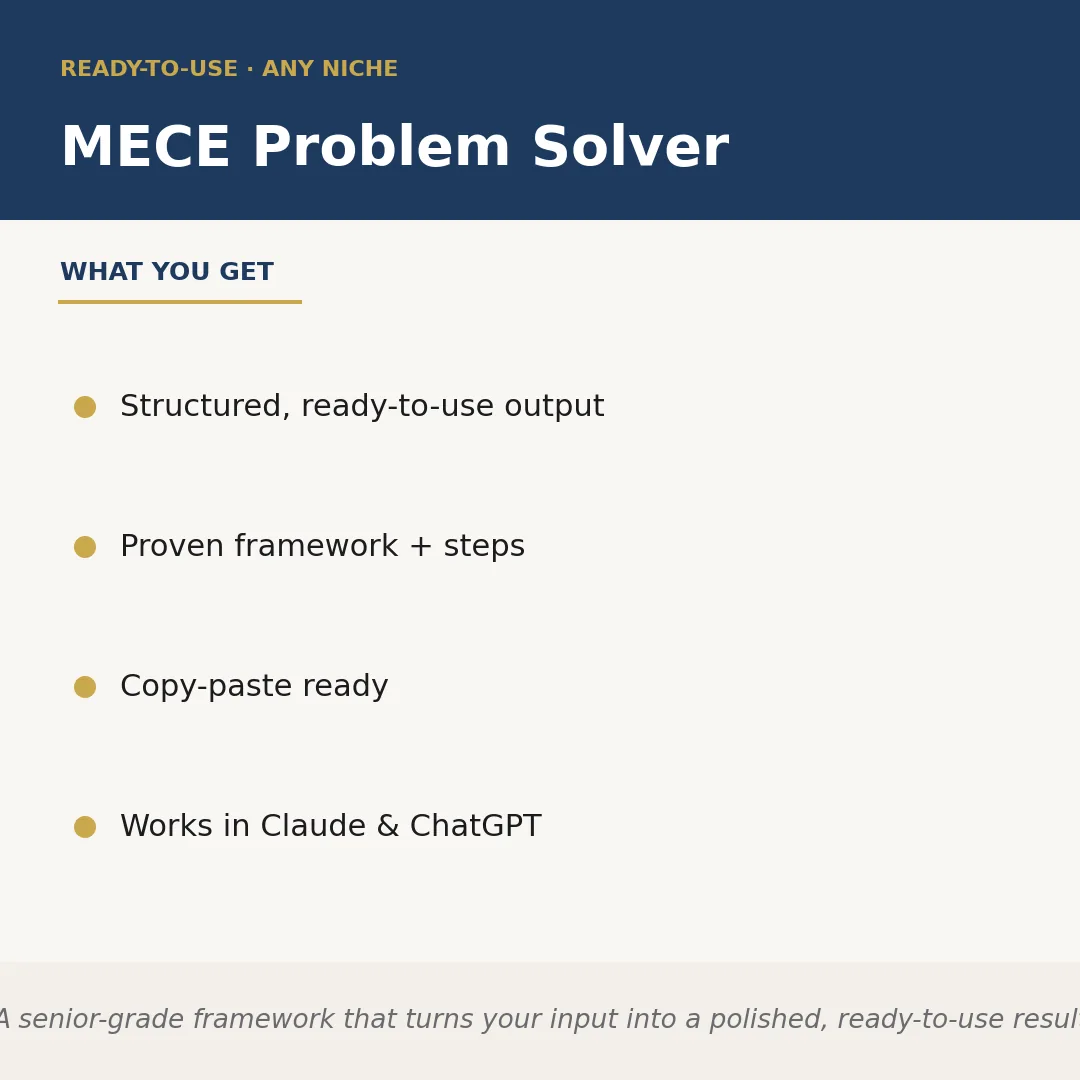
MECE Problem Solver is a Claude skill for Business & Consulting. A senior-grade framework that turns your input into a polished, ready-to-use result. It costs $5.99 on PromptBase. It runs on any Claude plan, including Free. Part of the StrategistKit catalog of 190+ focused Claude skills.
10 credits — included with a membership (30 credits/mo).
Prefer a one-time purchase, without joining?
Buy once on PromptBase (opens in a new tab) Also on Agensi — $8.99 (opens in a new tab)StrategistKit Affiliate. One-time purchase on PromptBase. Payment, delivery and refunds are handled by the marketplace — see their policy for refund terms. PromptBase purchases earn us a referral fee.
Overview
MECE Problem Solver applies the Mutually Exclusive, Collectively Exhaustive framework used by strategy consultants to break down any business problem you supply. You provide a problem statement and a niche or context; the skill maps every relevant dimension of that problem into clean, non-overlapping categories that together cover the full picture. The result is a structured decomposition you can hand to a team, drop into a slide deck, or use to drive a decision meeting — with no gaps and no double-counting.
A typical input looks like: 'My SaaS product has high churn and I need to understand all the possible root causes' plus the context 'B2B project management tool, SMB market.' The skill takes that and produces a MECE tree that exhausts the problem space — not a brain-dump, but a logically airtight breakdown with parent categories, sub-branches, and a brief rationale for each split.
Sample output excerpt — Root causes of SaaS churn (MECE): (1) Product factors: feature gaps, usability friction, reliability issues. (2) Commercial factors: pricing misalignment, contract terms, competitive displacement. (3) Customer success factors: onboarding failure, low adoption depth, support responsiveness. (4) Strategic fit factors: use-case mismatch at sale, ICP drift over time. Each branch is mutually exclusive; together they cover the full problem space with no overlap and no missing dimension.
Who it's for
Strategy consultants, product managers, and founders who need to structure a complex problem before a workshop, proposal, or executive presentation — and anyone who has ever built a messy list of causes or options and needed a defensible, exhaustive framework instead.
What you get
One .skill bundle. Run it on your material and it returns:
How it works
Add the .skill file to your Claude app. About 10 seconds.
Invoke the skill and paste in your material.
Review, keep what works, and use it.
In depth
A copy-paste prompt runs one static pass and stops. A skill is a bundled program — instructions, examples, and a workflow Claude runs as a unit: it asks for the right input, applies the same pattern every time, and returns the structured outputs above.
FAQ
A clear problem statement and the niche or context you are working in — for example, the industry, company type, or decision you are trying to make. The more specific your problem statement, the tighter the MECE breakdown the skill returns.
The skill returns a structured tree: top-level categories, sub-branches under each, and a brief rationale explaining why each split is mutually exclusive. It is formatted for copy-paste use in a document, slide, or messaging thread.
Yes. The niche and problem domain are runtime inputs you supply, so the framework adapts whether you are diagnosing a logistics bottleneck, sizing a market, or structuring a strategic decision. The MECE logic is domain-agnostic.
A brainstorm prompt returns ideas; this skill enforces logical structure. Every category in the output is checked for overlap (mutually exclusive) and the set of categories is verified to cover the entire problem (collectively exhaustive), which is the property that makes the output defensible in a consulting or boardroom context.
The output is designed to be copy-paste ready — structured, clearly labeled, and written in plain professional language. Most buyers refine labeling or add company-specific detail, but the logical skeleton is ready to use as delivered.
More in Business & Consulting
Part of these collections
We use cookies for anonymous analytics (read more). Accept, decline, or choose for yourself.